

In an instant, the silence broke.
“Aha, I found it!” one writer shouted, pointing excitedly toward an illustration mounted on an easel. “I love that story,” an illustrator exclaimed moments later. Around them, ASI executives burst into laughter. For months, they had guarded the annual secret at the heart of the April 12 event: Only they knew which artworks had been commissioned for which stories in the newest edition of one of speculative fiction’s most enduring anthologies, L. Ron Hubbard Presents Writers of the Future.
“A culture is as rich and as capable of surviving as it has imaginative artists.” —L. Ron Hubbard
That secret is finally revealed each year during the Writers & Illustrators of the Future workshop week in Los Angeles, where contest winners from around the globe meet for the first time, train under acclaimed judges and often form friendships that outlast the competition itself. The atmosphere is notably warm, as artists and authors who have just met begin interacting like longtime collaborators.
The tradition traces back to 1983, when Mr. Hubbard launched the “Writers of the Future Contest” as a platform for emerging authors of speculative fiction. In the first anthology volume, he wrote: “A culture is as rich and as capable of surviving as it has imaginative artists.”
Five years later, a companion competition for visual artists expanded that mission, opening the same door to illustrators working in science fiction and fantasy.
Today, the contest remains one of the field’s most distinctive talent pipelines. Every year, thousands of writers submit stories and illustrators present original fantasy or science fiction works. By design, the contest is reserved for up-and-coming talent—writers who have not yet professionally published a novel and illustrators still awaiting their first major break. Entries are judged anonymously by professionals, with cash prizes awarded throughout the year before grand prize winners are selected for the L. Ron Hubbard Golden Pen and Golden Brush awards.
This year’s anthology, Volume 42, showcases the remarkable range that has long defined the program—everything from bureaucratic satire and paranormal noir to emotional allegory and classic speculative wonder.
Among the standout entries is “Form 14B: Application for Certification of Consciousness Transfer (Post-Mortem),” by Melbourne, Australia-based engineer Thomas K. Slee. The story’s premise is pure high-concept science fiction: A wealthy influencer drowns while streaming a cave-diving stunt, but his digitized consciousness is stored in a tube, and he then attempts to reclaim his legal identity through government bureaucracy. Even in disembodied form, he refuses to surrender his will.
“His mind is in the tube, but he’s telling his lawyer what to do,” Slee told Freedom Magazine with evident delight, noting that his story—the anthology’s first—also carried “the longest title in the book,” stretching across two lines in the table of contents.
The accompanying illustration came from Vancouver, Canada-based Art Ikuta, known for his darker fantasy imagery. Used to keeping projects under wraps, Ikuta completed the piece nearly six months earlier and had been waiting ever since for the reveal. “It was a long wait,” he said.
A very different energy drives “In Living Color,” by Cincinnati writer Michael T. Keuster, who sold his first professional story to the anthology series after entering the contest three prior times. His protagonist, August, can enter pictures and connect with the emotions of those depicted in them. What begins in Claude Monet’s “Water Lilies” masterpiece soon becomes a crime investigation—then a hunt for a serial killer.
“I’m a sci-fi writer, so most of my stuff takes place in the far future,” Keuster said. “But this is actually the only story I’ve ever written that takes place in my hometown.”
For Indiana illustrator Nathan Deiwert, the story he was assigned to bring to visual life landed with unusual force. “I was just on the edge of my seat the entire time,” he recalled. Though noir is not normally his genre, Deiwert leaned into the assignment with meticulous care, determined to match the story’s emotional weight.
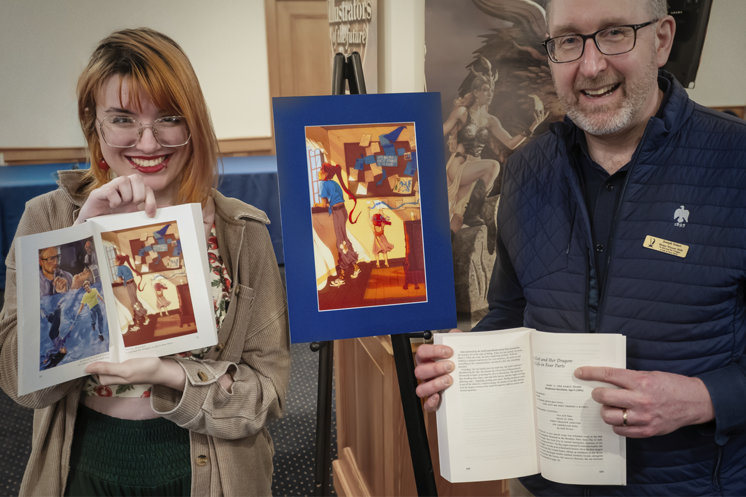
Equally memorable is “A Girl and Her Dragon: A Life in Four Parts,” by Boston physician Joseph Sidari. The idea for the tale began after he read about activists who released an owl from the Bronx Zoo. “I wondered what would happen if it were a dragon instead of an owl,” he said.
The dragon, however, isn’t the story’s true center. That place belongs to the narrator, a girl whose life unfolds—from childhood into her seventies—in the shadow of the captive creature she longs to free. What initially appears to be a fantasy adventure becomes a meditation on longing, growth and liberation.
The story’s illustrator, Massachusetts artist Josie Moore, felt an immediate personal connection to the protagonist. “I was very shy growing up,” she said. “So instead of really knowing how to express my emotions, I showed it through my art.” Her finished image depicts a young girl creating artwork indoors while an older woman looks toward the open sky—a portrait of one life divided by time yet united by the same desire for freedom.
Over the decades, the Art Reveal has become one of the signature moments of the Writers & Illustrators of the Future week, second only to the annual Awards Gala. Its appeal is simple but powerful, not least because it lifts solitary work out of isolation into a shared moment of discovery and delight. Stories conceived and written privately unite with images created behind the scenes—and both are finally unveiled and celebrated in public.
John Goodwin, president of Galaxy Press, which publishes and markets Mr. Hubbard’s fiction works, told Freedom that seeing writers discover the art inspired by their stories, together in a single room, never loses its impact.
Each year, writers worry their stories may be impossible to illustrate, while artists fear their work may go unnoticed, Goodwin said. Then the doors open, the writers walk the room, stop in front of a painting, and say the same words:
“This is it!”