


The clash, with potential civil penalties looming, has produced one of the sharpest rebukes of the office’s freedom of information practices in recent memory.
The case matters far beyond one requester or one invoice.
In a December 23 recommendation, a Connecticut Freedom of Information Commission official overseeing the case concluded that the Attorney General’s office improperly required prepayment for public records, failed to justify its fees under statute, and operated under an arbitrary and unpublished policy that undermined the public’s right to access. The finding ordered records released unredacted and free of charge, and warned that sanctions could follow after a final commission decision scheduled for January 14.
The case matters far beyond one requester or one invoice. At stake is whether Connecticut’s highest legal office may condition access to public records on advance payment unsupported by law—and whether freedom of information obligations are treated as a core governmental duty or an inconvenience to be managed away.
The dispute arose from a November 2024 freedom of information request submitted by Glastonbury software engineer Nathaniel Clark, who sought records related to cases involving the state Commission on Human Rights and Opportunities. The request landed at the Office of Attorney General William Tong, where it triggered a demand for a $650 upfront fee before any work would be undertaken.
According to the hearing record, Clark was repeatedly told that the office would not proceed without payment first. At a November 25 hearing, he summarized the position conveyed to him bluntly: “You need to pay us before we’ll do anything.” Clark responded just as plainly, telling the commission, “That’s bulls—t. That’s not what the law says.”
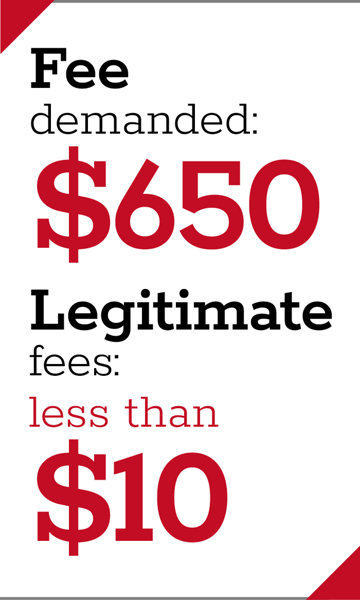
Commission staff attorney Zach Hyde, acting as hearing officer, rejected the Attorney General’s office’s justification for the demand. In his written finding, Hyde stated: “It is entirely improper for the respondents to request prepayment of estimated fees predicated on costs that would ultimately need to be waived” (that is, costs not legally chargeable under the Freedom of Information Act).
He further concluded, “The respondents failed to prove that the estimated total for legitimate fees equaled or exceeded ten dollars.”
Hyde also expressed alarm, writing that the commission was “concerned by the arbitrary and ill-defined nature of such unpublished, informal policy” governing advanced fees. He cautioned the office “to reconsider” their procedure.
At the hearing, Assistant Attorney General John Langmaid attempted to downplay the relevance of internal standards, arguing that policy guidelines were immaterial. Meanwhile, his colleague, Antonia Howard, testified that no written policy regarding upfront fees existed. The absence of a formal policy, however, only sharpened the commission’s concern about discretionary barriers to access.
The record showed that the office initially demanded the $650 prepayment on January 3, 2025. A week later, an email assured Clark that he was not being denied access to records. Clark responded on January 14 by asking, “If I am not being denied any records, as you assert, I should be able to come inspect them; when can I do that?”
The office directed him back to prior emails. He was never allowed to inspect the documents.
Hyde also took aim at the broader posture of the office toward transparency. He wrote that freedom of information obligations were “in practice, treated by the Attorney General’s office as subordinate to their other duties.” This conclusion was grounded in sworn testimony from Howard, who told the hearing she felt she was “neglecting” her regular responsibilities while working on the request and described a practice of charging requesters when a FOIA response “takes employees away from their normal course of duty for a long period of time.”
In one email expressing frustration with a document request, a paralegal referred to a complainant as a “pistol” and an “a—hole.”
That mindset, Hyde concluded, was incompatible with the law. Citing a Connecticut Superior Court decision, he emphasized that a public agency’s obligations under FOIA must be regarded as a “primary duty,” “on par with the agency’s other significant duties” and not a “second-class duty.” The critique framed the fee dispute as symptomatic of a deeper institutional failure to internalize transparency as a core function of government.
The Clark case is hardly an outlier. The Attorney General’s office is currently appealing other Freedom of Information Commission rulings involving advance fee demands exceeding $16,000 and $40,000. Those appeals have intensified scrutiny of whether fee estimates are being used as deterrents rather than cost-recovery mechanisms, as permitted by statute.
Internal communications disclosed during related proceedings further complicated the AG office’s position. In one email expressing frustration with a document request, a paralegal referred to a complainant as a “pistol” and an “a—hole”—language that underscored the adversarial tone some requesters say they encounter when seeking public records.
The commission is expected to issue a final decision on January 14. Hyde has warned that civil penalties may be considered for any ongoing violations after that date, raising the stakes for an office that serves as Connecticut’s chief legal authority. A final ruling affirming the recommendation would not only compel compliance in this case but could recalibrate how agencies across the state approach fees, timelines and access.
For advocates of open government, the message is unambiguous: Public records are not commodities to be rationed by price or patience. As Connecticut’s Freedom of Information Commission weighs its final decision, the outcome will test whether transparency is enforced as a statutory right or quietly negotiated as a privilege subject to retainer.