

The procession—3.2 miles of floats, dancers and classic automobiles moving through the heart of Tinseltown—brought together some 5,000 participants, from television icons and social media stars to Native American powwow dancers and Korean youth performers, turning Hollywood Boulevard, Vine Street and Sunset Boulevard into a moving festival of light and sound.
For Los Angeles, the parade is more than a spectacle. Born in 1928 as the “Santa Claus Lane Parade” to lure shoppers to Hollywood Boulevard, the event has evolved into a nearly century-old ritual that blends entertainment with philanthropy—supporting Marine Toys for Tots while giving Angelenos of every background a place to stand side-by-side, if only for a few hours, in uncomplicated celebration.
“No matter what divides us, we do all come together to celebrate.”
This year’s edition leaned fully into that blend of spectacle and service. On the street, Angelenos truly saw what the numbers only hint at: 85 Hollywood celebrities and VIPs, 15 pre-parade and parade performers, seven award-winning marching bands and just as many floats, 24 novelties and 45 movie cars—from Back to the Future DeLoreans and Fast & Furious street racers to the Ghostbusters’ ECTO-1 and Lightning McQueen.
The evening began in earnest on a 330-foot red carpet stretching in front of Author Services, Inc. (ASI), the five-story Hollywood Boulevard building that serves as the literary agency for bestselling author L. Ron Hubbard and has, since 2010, quietly become one of the parade’s essential backstage engines. With parking atop its upper floors, ASI now serves as the staging area for the celebrity-laden convertibles that are the parade’s signature: On Sunday, some 40 classic cars lined the roof before rolling down into the night, stars waving from their open tops.
From that same building’s green room, the celebrity dog trainer, “pack leader” and Mexican-born author Cesar Millan watched with four of his dogs, radiating the calm and charisma he’s known for. Asked what moment he would freeze from the night, he didn’t pick a luminary or a float. “The smile of my grandkids,” he told Freedom. “They’re not here but they knew I was coming.”
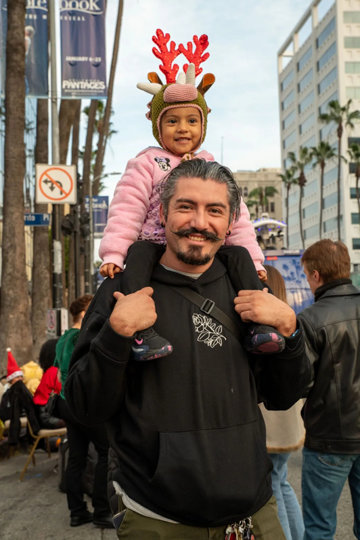
Millan saw in the crowd something that Hollywood often struggles to project. “Joy looks the same way as when we are kids and we just woke up in the morning and we know that we are alive,” he said. “That’s it. It’s just a joy to be alive.” For him, celebration is not a diversion but a kind of medicine. “Anything that has to do with joy and brings together community is the quickest way to heal,” he said, describing the atmosphere on Hollywood Boulevard that night as “amazingly safe and peaceful.”
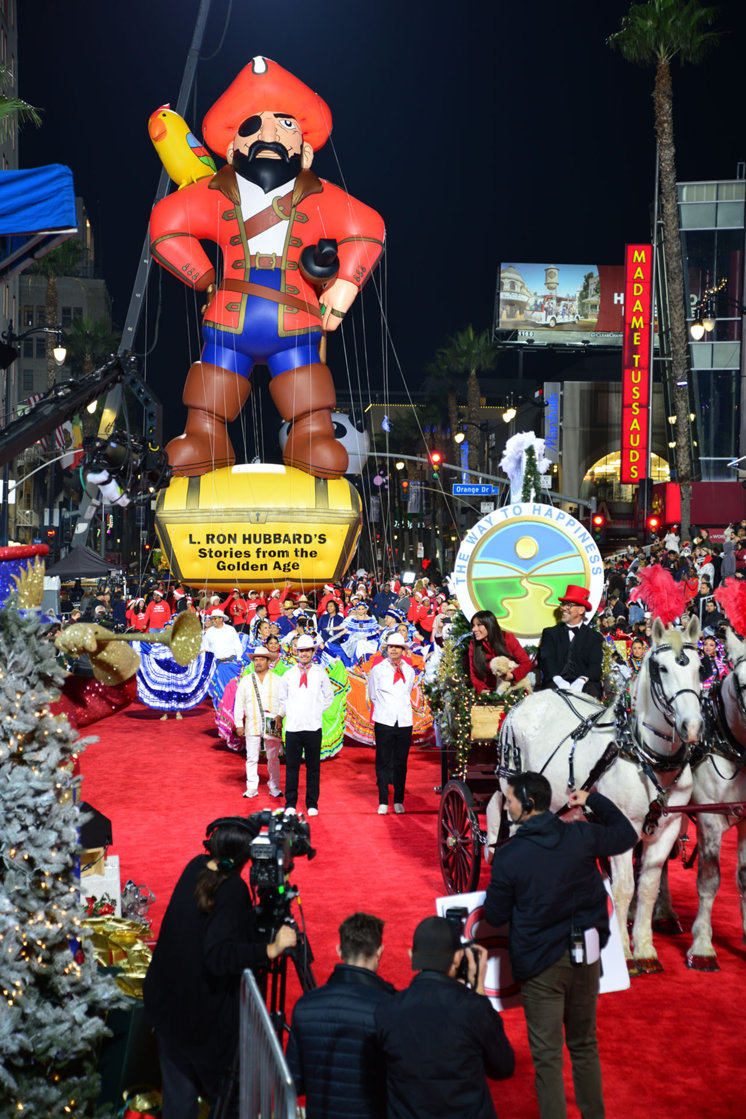
On the pavement below, that joy took some decidedly larger-than-life forms. Among the nine character balloons, a five-story pirate—Captain Tom Bristol, from Mr. Hubbard’s high-seas adventure Under the Black Ensign—loomed above the boulevard, tethered by some 30 volunteers managing the lines as gusts of wind threatened to send the corsair truly airborne. The helium balloon was part of a “Pirate and Chest” entry sponsored and wrangled by Galaxy Press, which publishes Mr. Hubbard’s fiction. The organization’s president, John Goodwin, summed up the sight with a laugh: “We like to say that Captain Tom Bristol is riding the airwaves of Hollywood Boulevard.”
Featuring actress Marisol Nichols, The Way to Happiness float—spotlighting the non-religious moral code’s 21 common-sense precepts, written by L. Ron Hubbard to counter society’s eroding moral values—carried an unexpected companion: Cri-Cri—El Grillito Cantor, the beloved singing cricket known across Mexico. The fictional character, created in 1934 by composer Francisco Gabilondo Soler for his children’s program on Mexico’s XEW radio station, rode the parade accompanied by Soler’s grandson, Francisco Sanz Polo Gabilondo.
For many Latino families on the route, seeing the tuxedoed little cricket—famous across generations in Spanish-speaking households—folded into a Hollywood holiday tradition sent its own quiet message: This parade belongs to them, too. Cri-Cri’s whimsical songs and characters have been described as a cornerstone of childhood for generations of Mexican children, from his 1930s radio broadcasts to today’s recordings and streaming playlists.
If the floats at the parade showcased a particular kind of cultural memory, the food trucks and service tents showed a hands-on form of goodwill. Near the red carpet, an In-N-Out Burger truck turned out a steady stream of free burgers for police officers, celebrities, VIPs and volunteers. Supervisor Brianna Aguilar described why the company came: “We love to work with communities, providing customer service and making sure everyone’s happy.” The highlight of serving at an event where smiles never stopped? “Making everyone happy, taking care of them!”
On the other side of the carpet, Los Angeles marketing executive Rick Schirmer—CEO of ViralBrand, the agency credited with the high-profile launches of films such as Toy Story, Monsters, Inc. and Harry Potter—accompanied his wife, host Rachel McCord of The McCord List Today, as she worked a gauntlet of cameras in a black dress, their Chihuahua, Peanut, in a tiny Santa outfit. Schirmer had missed the parade for nearly three decades, but the atmosphere made the first time feel instantly familiar. Surrounded by strangers, he didn’t feel distant: “Anytime the community can come together,” he said, “it’s a great thing—people of all persuasions celebrating in the holiday spirit.”
That theme—of ordinary Angelenos finally stepping into a ritual they had only seen on television—turned up again and again along the barricades. Social media manager and singer-songwriter Shannon Easter, who recently moved with her kids from Marina del Rey to West Hollywood, said this was the first time she and her children had experienced the Hollywood Christmas Parade. “Ultimately, it got me and my kids out tonight for some Christmas magic,” she said.
In a year she described as tumultuous, the parade offered something solid to rely on. “In times when things might be uncertain, this is about holding onto the fact that we can choose to make memories together and we can choose joy … and not lose the holiday season in spite of what we feel is up against us,” Easter said. As she took it all in, the sheer scale of the floats—far larger than the ones from her Georgia childhood—made the night feel proportionate to the importance the holiday holds for her family. “Now it feels like the festivities match—in size—how much we really value it,” she said.
Asked what it felt like to stand shoulder-to-shoulder with strangers when the national conversation often dwells on division, Easter didn’t hesitate. “No matter what divides us, we do all come together to celebrate—we do all need peace and we need things that bring us peace and joy in our lives,” she said. Events like this, she added, offer a chance “to put everything else aside and just enjoy a moment in the same second—breathe the same air, without it being volatile.”
“We see it all the time in law enforcement—that the majority of time when people come together it is for peaceful reasons.”
For Los Angeles County Sheriff Robert Luna, watching thousands of people line the route was a reminder of the true face of the city he sees in statistics and incident reports. “This is what it’s like and this is what it should be like,” Luna told Freedom. “We see it all the time in law enforcement—that the majority of time when people come together it is for peaceful reasons. And if you look at the cause out here, they’re celebrating law enforcement, they’re gathering funds for families and everything that people need to get through the Christmas season.”
What does a night like this reveal about Los Angeles that people often overlook? “The generosity,” Luna answered. “That people really care about each other. We get caught up in the negative news when something bad happens.… But we need to focus on all the good and not all the bad.”
“It’s very important,” he said.
On the Marine Corps side of the street, First Sergeant (Ret.) Bill Holodnak marched with fellow service members and a Corps brass band at the heart of the Toys for Tots contingent. “It’s a great event for Toys for Tots and for raising hundreds of thousands of dollars” for the cause, he said. The band’s performance, he added, was meant to help “support poor and rural communities in the world.”
The Marine Corps’ work continues a tradition that began in 1947 when Marine reservists in Los Angeles collected 5,000 toys after Major Bill Hendricks’ wife, Diane, encouraged him to create an organization that could help children in need.
“Toys for Tots and the Marine Corps are tied together. The Marine Corps supports Toys for Tots. Marines go out and raise money and donate toys to underprivileged children,” Holodnak explained. Asked how his group prepares for an event watched by millions, he smiled and gestured toward his uniformed colleagues in their trademark white peaked caps.
“Marines are Marines 24 hours a day,” he said. “Marines participate by staying in shape, leading in the front, and having moral courage to do the right thing.” The moment that gave him chills, he added, was “probably seeing all the support and donations come in” for those who need it most.
Presiding over the entire spectacle from the front of the procession was Grand Marshal Luke Wilson, the Emmy-winning actor known for films ranging from Legally Blonde to The Royal Tenenbaums. “I’m honored to serve as the Grand Marshal of this year’s Hollywood Christmas Parade—joining an esteemed list of Hollywood legends—and excited to support Marine Toys for Tots to bring joy to children in need this holiday season,” Wilson said in a statement.
Actor and producer Anthony Anderson, recognized as the Parade’s Humanitarian of the Year for longstanding philanthropic work through his foundation, framed the honor in similar terms. “I am so thankful to be acknowledged for my charity work by such a respected establishment in the Hollywood community,” he said.
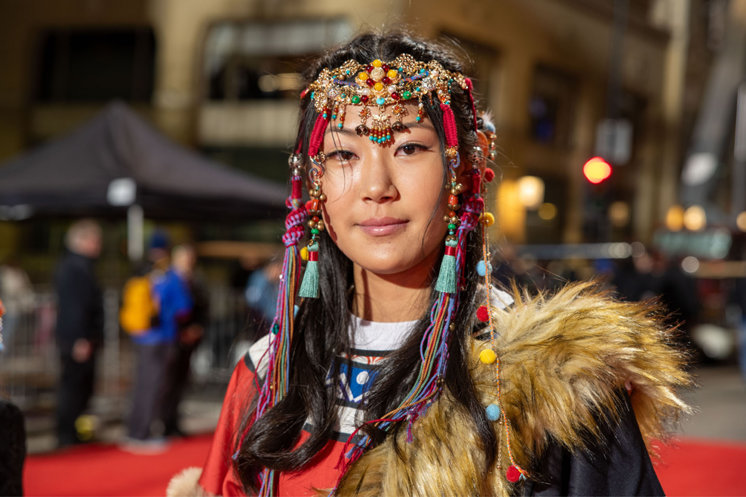
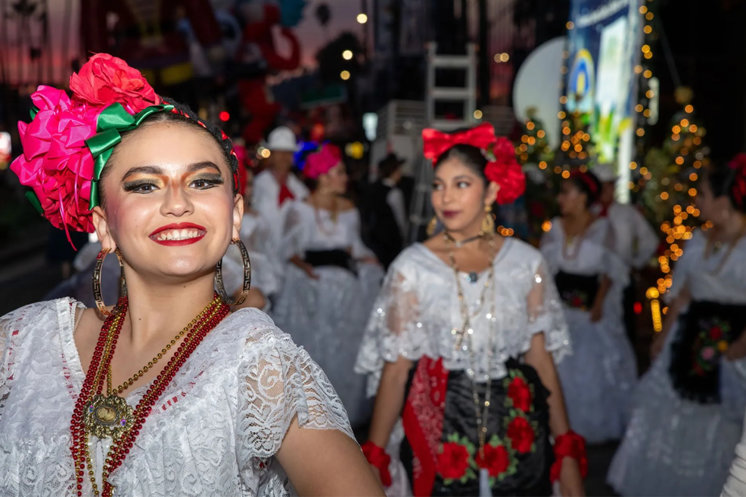
Around the parade’s leaders marched bands from California, Indiana and Florida; a Bolivian dance group and a Panamanian float in brilliant traditional costumes; Korean American youth performers; cheer squads; bicycles lit up like rolling constellations; and Star Wars fan organizations turning out more than 180 costumed characters and a fleet of custom-themed vehicles. Together, they turned a single city street into a map of overlapping cultures, each allowed its moment in the spotlight.
For those who couldn’t make it, the night will reappear on screens soon enough: The 93rd Hollywood Christmas Parade was taped for a national primetime telecast on The CW Network scheduled for December 12, and will also air on the American Forces Network and via streaming on the Popstar! app, extending Hollywood Boulevard’s holiday moment to households across the country and to US service members abroad.
But for the people who stood pressed against the barricades as Santa’s float finally came into view, the broadcast will likely serve as only a reminder. What they are bound to remember is something closer to what Cesar Millan described: the simple joy of being alive in a city that, for at least one night, felt unexpectedly unified, even close-knit. Or what Shannon Easter articulated as the choice to make memories together even when the wider world feels uncertain.
Nearly a century after Santa first rode down a rebranded Santa Claus Lane, that may be the parade’s quietest accomplishment: Year after year, it gives Angelenos a chance to prove Sheriff Luna right—that when people gather, the instinct toward peace and generosity still outweighs the rest.
And as long as children keep craning their necks toward a pirate balloon, a singing cricket, or a jolly man in a red suit, the Hollywood Christmas Parade seems poised to keep returning each Thanksgiving weekend, inviting the city to come back out into the street and choose joy once again.