

And now, Ontario is giving the public a reason to ask what, exactly, it doesn’t want seen.
The province’s latest attempt to expand government secrecy is already raising alarm among transparency advocates in Canada and beyond.
It all began with a legal decision on December 29, 2025, requiring that Ontario Premier Doug Ford release records from his personal cellphone that relate to government business.
“If records about government business can be shielded from scrutiny simply because they sit in a minister’s office, on a staffer’s device or within a political account, public accountability is eviscerated.”
Initially, a reporter had sought the call logs of Ford’s government-issued cellphone under the Freedom of Information and Protection of Privacy Act (FIPPA)—but the Cabinet Office released invoices showing there were no calls made for months.
Really? Not even one?
The reporter didn’t buy it. He requested records from Ford’s personal phone instead. And despite an order from the Information and Privacy Commissioner to release the records, the Cabinet Office refused.
So the case went to court. And Ford lost.
But the story didn’t end there.
What do you do when you’re a powerful politician and the law doesn’t protect you?
You rewrite it.
In fact, you propose and push for a new law that amends FIPPA and establishes some of the most restrictive blockades to transparency in history.
Under the new law, freedom of information rules would no longer apply to records held by the premier, cabinet ministers, parliamentary assistants or political staff—effectively shielding all their actions from public scrutiny.
And since the proposal includes retroactive secrecy, those records would remain permanently out of reach.
You want to know what your government is up to, Ontarians? Good luck—because if this bill is passed, they won’t have to tell you squat.
Of course, government spokespeople in favor of the proposed new law cast it as a long-overdue movement toward “modernization” and “privacy protections.”
In reality, the proposed changes to Ontario’s transparency laws would do the opposite of what those laws are meant to do.
Alasdair Roberts, a Canadian government transparency expert and professor of public policy at the University of Massachusetts Amherst, has documented the tendency of governments around the world to conduct their business in ways that limit public access.
“There was a heyday between 1995 through to about 2010 or so—a period where countries and everybody were talking the language of transparency,” he told Freedom Magazine. “Dozens and dozens of countries adopted freedom of information laws.”
But, he notes, “For the last 15 years, people who advocate for transparency have been on the back foot. Political mood has changed and governments are more concerned with crisis management and economic and national security, becoming more nationalistic and more defensive.
“Governments are saying we can’t afford transparency as much as we thought we used to. We think these laws are not worth it. It’s a risk that we don’t want to take.”
The shift has been taking place for quite some time, with various methods being employed by bureaucrats to avoid releasing information. They delete records, charge exorbitant fees for research and copying, or practice “slow-rolling” responses until people give up and walk away. They claim classified status for information that doesn’t meet classification standards, or “glomar” an inquiry—refusing to confirm or deny that the records even exist.
But in Ontario, if these laws pass, there will be no need for trickery: Requests can be refused outright.
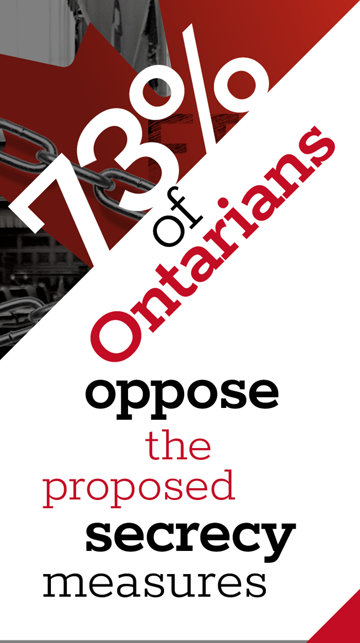
Citizens are largely against the new regulations. Only 24 percent support them, while 60 percent oppose them. Mention the retroactive provision and that number jumps to 73 percent, according to a poll by Abacus Data.
Information and Privacy Commissioner Patricia Kosseim released a statement in strong opposition to the proposed legislation, saying, “By changing the law retroactively, the government’s message is plain: If oversight bodies get in the way, just change the rules.
“Freedom of information laws exist to provide Ontarians with vital information about how government decisions are made, on what basis, who influenced them and whether the public interest is being served. If records about government business can be shielded from scrutiny simply because they sit in a minister’s office, on a staffer’s device or within a political account, public accountability is eviscerated.”
And when accountability is stripped away, someone has to push back.
The Church of Scientology has been one of the Freedom of Information Act’s oldest and fiercest advocates. It has a long and proud history of taking government agencies to task that attempt to withhold information.
As Scientology Founder L. Ron Hubbard once wrote, “Democracy depends exclusively on the informedness of the individual citizen.”
And right now, that informedness is under direct attack.
We call on Ontario to wash the windows and let the light shine in.
For the future of democracy, it’s crucial that we have more, not less, government transparency.