

That rhythm yielded earlier this year to a different kind of appeal, when Ivan Arjona, president of the Foundation for the Improvement of Life, Culture and Society and president of the European Office of the Church of Scientology, delivered his remarks before the UN Human Rights Council in verse—bringing a legal fight over religious discrimination down to its human stakes: work, conscience and bread.
“I wanted to break through the formal tone and make people listen,” Arjona told Freedom Magazine, describing poetry as “probably the oldest and most lasting and powerful system of protest communication.”
“They cannot compete because of their religion, even if they are better professionals.”
Arjona’s poetic appeal on March 16 focused on a practice that has persisted in parts of Germany for decades: the use of so-called “sect filters,” written declarations that require individuals or companies to affirm they have no association with a particular religion, or will employ no one who does.
At stake is a narrower question than theology and a broader one than any single religion: whether access to employment, public contracts and economic participation can be conditioned on disavowing or distancing oneself from a faith.
In practice, a sect filter, also known as a “protective declaration” (Schutzerklärung), is a written test of association and belief imposed on applicants, contractors or recipients of subsidies.
Applicants in some public-sector contexts may be required to complete detailed questionnaires confirming they have no ties to Scientology, have not attended its courses and will not apply its teachings in professional settings. These forms can extend to disclosing past participation in religious activities, associations with specific groups and even expressions of ideological support.
Similar requirements also surface at the institutional level. According to Arjona, these patterns appear across multiple professions, with the clearest evidence to be found in government contracting. When public agencies in Germany issue tenders for goods or services above certain monetary thresholds, they are required to publish the full contract terms—documents in which sect filter clauses frequently appear.
In Arjona’s account, those who refuse to sign declarations may lose job opportunities and face barriers to career stability, including limits on advancement and access to public contracts. “They cannot compete because of their religion, even if they are better professionals,” he said.
Arjona argues the term “Faith-Breaker clause” more accurately captures the policy’s effect. “It basically attempts to force signers to break away from their faith,” he said, describing a choice between livelihood and religious belief.
According to Arjona, “every single weekday” brings new instances where such clauses appear, particularly in Bavaria.
German courts have repeatedly found aspects of the practice unlawful. In April 2022, the Federal Administrative Court ruled that denying a subsidy to an applicant who refused to sign such a declaration violated constitutional protections of religious freedom and equal treatment under the law. Earlier administrative and labor court rulings reached the same conclusion, rejecting employment decisions and security determinations based solely on religious affiliation.
Taken together, the rulings leave little ambiguity: Public authorities cannot make jobs, funding or other benefits depend on declarations about belief. Yet sect filters remain in use, exposing the gap between court rulings and administrative practice.
Arjona attributes that persistence to institutional inertia and political caution, arguing that officials may hesitate to revisit or dismantle established practices even after courts have ruled against them.
Legal experts have long noted that individual court victories rarely translate into broader administrative change. The US State Department, for example, notes that legal disputes involving Scientology in Germany have stretched over years without final resolution, with many issues remaining unsettled. Each case typically requires separate litigation, a process that can take years and impose significant costs on those forced to challenge the policy one case at a time.
The record shows what that burden looks like. In multiple cases before German administrative and labor courts, applicants challenged employment denials or subsidy decisions tied to declarations, with proceedings lasting years before courts ordered reinstatement, compensation or reversal of the decision.
“People should be judged by their competence, conduct and qualifications—not by their conscience.”
In one instance, an airport technician barred from secure areas based on his identification as a Scientologist regained access only after a court ruling. In another case, a musician who was denied a subsidy ultimately prevailed after her appeal reached the highest administrative court in the state.
“Having to fight each case defeats the purpose of justice,” Arjona says.
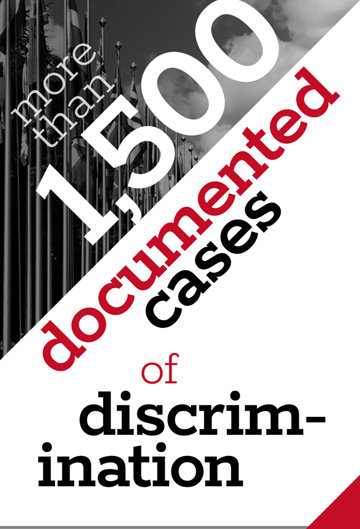
The Church of Scientology has identified more than 1,500 documented cases of discrimination, though the true number may be higher due to limited reporting mechanisms. The scale and persistence of the practice have kept it on the radar of international human rights bodies for decades.
In addition to repeated findings by the US State Department, a 1998 UN report criticized sect filters as inconsistent with human rights standards.
But the practice has persisted.
Arjona argues that international bodies have failed to press Germany hard enough, leaving years of official criticism without meaningful enforcement or reform.
Scientologists are not the only ones subject to religious screening. Reports from 2023 describe a questionnaire used by a state-supported Lutheran institution in Bavaria that asked applicants about affiliations with Hare Krishna and Jehovah’s Witnesses, among other groups.
In his address to the Human Rights Council, Arjona called for UN Special Rapporteurs on freedom of religion, expression, minority issues and privacy to investigate Germany’s use of sect filters directly through on-site visits, interviews with affected individuals and reviews of procurement and administrative records. The point, he said, is to move beyond written submissions and let international bodies see the system for themselves.
“Once they have done this, they can expose it in the international arena,” he said.
Arjona says Germany should acknowledge that sect filters violate constitutional and international human rights standards, remove them from tenders and employment processes, and bar similar requirements from returning under another name.
“In practical terms,” he said, “people should be judged by their competence, conduct and qualifications—not by their conscience.”
Asked to distill his message into a single sentence, Arjona returned to the idea that framed his address in Geneva: “Conscience is a fundamental human right, and no society is truly free when people must hide or renounce their faith to earn their bread.”