

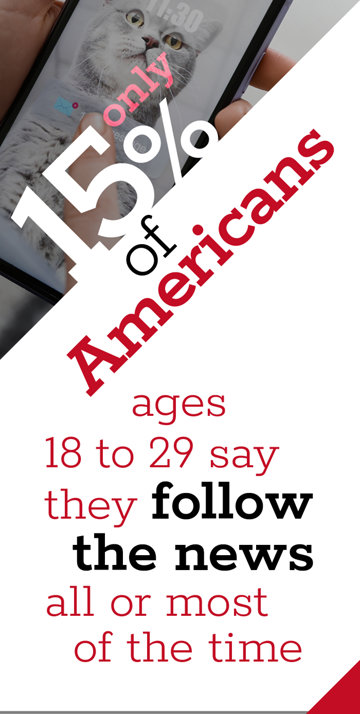
Only 15 percent of Americans ages 18 to 29 say they follow the news all or most of the time, compared with 62 percent of adults 65 and older—a gap the Pew Research Center describes as both persistent and widening.
Rather than seeking news, young Americans tend to bump into it—particularly through social media influencers. Many say the experience leaves them overwhelmed, confused or anxious—as one 24-year-old woman told Pew, “I try to avoid it for my sanity. If I watch too much of the negativity in the news, it affects my mood.”
Many say they would prefer to hear from those they know and trust than through gatekeepers they view as biased and alarmist.
That instinct to protect one’s own mental space from a relentless drumbeat of bad news is hardly novel. For decades, critics of mainstream media have warned that sensationalism, conflict framing and the constant hunt for villains can warp public perception—and ultimately erode trust. Today’s youngest news consumers experience that erosion firsthand. Many say they would prefer to hear from those they know and trust than through gatekeepers they view as biased and alarmist. As Scientology Founder L. Ron Hubbard once observed, habitual exposure to negative news can erode one’s peace of mind—a point today’s 18- to 29-year-olds seem to be discovering for themselves.
This awareness matters because it signals a redefinition of what journalism is, who counts as a journalist, and what kind of authority—if any—legacy newsrooms can expect to hold in the decades to come.
The future of reporting, in other words, may hinge on a cohort that does not believe it needs news in the way older Americans once did—and is building its own information systems instead.
Published December 3, Pew’s new analysis shows that the divergence is not about a single factor but reflects a deeper structural realignment: Young adults follow fewer traditional beats—politics, government, science, business—and gravitate toward entertainment. Just 22 percent say they intentionally seek out news often; 7 out of 10 encounter political news incidentally while doing other things online.
Their emotional response is pronounced. One-third of young adults report that news often makes them feel scared or confused, while older adults are far more likely to say they feel informed. For many younger Americans, news consumption thus feels like an intrusion rather than a resource, making disengagement a form of self-protection.
They also report weaker attachment to their local communities—a factor Pew identifies as likely correlated with lower news consumption: When community feels abstract, Pew suggests, the incentive to follow local news can weaken.
Where young adults do engage, they overwhelmingly do so through digital channels. As many as 93 percent get news through digital devices, with 76 percent receiving it at least sometimes from social media—a 48-point gap compared with the 65-plus population. Instagram and TikTok dominate, and many young adults say those platforms deliver breaking news faster than any newsroom.
One 22-year-old woman described learning of a major event this way: “I first saw on TikTok … then I saw an article the next day on Fox News and other different news sites.”
The most transformative finding may involve news influencers—social media personalities with large followings who regularly post about current events and civic issues. Nearly four in 10 adults under 30 say they regularly get news from such figures, who often have no institutional affiliation but command personal credibility. As one 21-year-old man put it, “If I agree with that person already … then I’ll probably trust him more than some news site.”
This preference for familiarity reflects a broader trend: Information is trusted when it is personal. Trust flows horizontally through networks of affinity, not vertically from established newsrooms to the population at large.
It is a systemic challenge to the model that sustained American journalism for a century: the idea that reporters, not peers or personalities, serve as primary narrators of public events.
Young adults also show openness to multiple information channels—podcasts, newsletters, search engines, even AI chatbots (13 percent report using them at least sometimes)—further diluting the influence of traditional outlets.
Perhaps the most consequential change is conceptual: Young adults define the word “journalist” far more broadly than older Americans—many include newsletter writers, podcast hosts and social media content creators. Only half say they prefer news from people they consider journalists, a proportion far below that of older consumers.
That wider journalistic umbrella expands the field but challenges norms that once governed it. Younger Americans are far more accepting of journalists expressing opinions, political views or personal beliefs. Sixty-three percent say it’s acceptable for journalists to advocate for communities they cover on social media—compared with 45 percent of those 65 and older—while roughly a third say it is acceptable for journalists to publicly express political or religious views, which is double the share among the oldest group.
One 24-year-old man noted, “I don’t hold it against them if they take a side. I just want it to be explained why they’re taking that side.” A 27-year-old woman added, “If I can personally relate to the journalists’ views … I’m just more likely to find them trustworthy.”
This suggests a generational reorientation: Transparency of identity can build trust, while neutrality feels less relevant in a media environment built on participation.
Half of young adults say they trust information from social media “a lot” or “some”—the highest share of any age group. Meanwhile, they express limited trust in local and national news organizations. Few major news sources are trusted more by young adults than by older ones.
Many say traditional outlets feel superficial or incomplete—too negative and alarming and not focused enough on the fuller picture.
As a 25-year-old woman said, “Oftentimes I find myself having to seek alternative news outlets … to fill in the gaps of missing details.”
For news organizations already struggling with declining revenue and fragmentation, this represents more than a generational shift. It is a systemic challenge to the model that sustained American journalism for a century: the idea that reporters, not peers or personalities, serve as primary narrators of public events.
If younger adults point the way forward, the future is neither a return to mass-audience monoculture nor a collapse. It looks instead like a pluralistic, interconnected ecosystem in which authority is fluid, trust is conditional, and news competes with innumerable other forms of storytelling.
The challenges for legacy newsrooms are substantial, but they also create opportunity. Young adults show strong appetite for authenticity, immediacy and transparency; they trust creators with whom they feel a connection; they want reporting that provides real context; and they want to understand a journalist’s perspective rather than pretend it does not exist.
The path forward may require news organizations to rethink their relationship with audiences: less gatekeeping, more explanation; fewer rigid formats, more adaptability; stronger community ties, fewer assumptions about built-in trust.
Young adults already stitch together their own information networks. The question for newsrooms is whether they will be part of those networks, or simply a relic of another legacy era.
One thing is certain: The future of news will not be inherited by institutions that believe trust is owed to them.
Those are the ones that are already disappearing.