

The Indian educator—who runs Applied Scholastics language schools in Chennai and Colombo—had traveled halfway across the globe to be honored for her humanitarian work. As the moment unfolded, what rose with it were the faces and classrooms that had brought her there in the first place: tea plantation students in Sri Lanka, children who had never been taught how to study and teachers who had never been shown another way.
“I’m still out of words for that because it was amazing,” Sundar tells Freedom, referring to the acknowledgment she received at the event. “Am I really deserving of this?” she thought. “But I felt very, very honored.”
“At night, when I sleep, I cannot tell myself, ‘Oh, I did my job of teaching by just scribbling notes on the blackboard.’”
Recognition, for Sundar, is not an endpoint. It is a momentary pause in a decades-long effort to address what she sees as a foundational failure in education across South Asia, where millions of students are expected to perform without ever being taught how learning itself works.
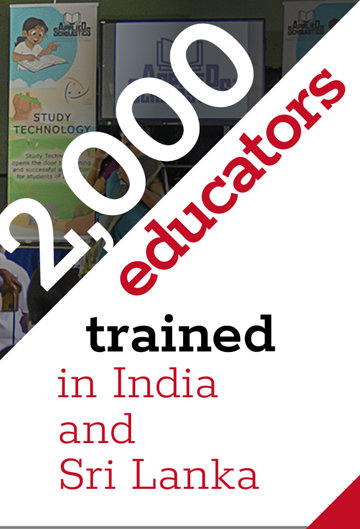
Her conviction—born early in Sundar’s career and sharpened through years of classroom experience—has driven her to establish Applied Scholastics centers in Sri Lanka and India, introduce Study Technology to more than 2,000 educators, and reach thousands of students who once struggled to simply read.
But the significance of Sundar’s work lies not in scale, but in method. At a time when education systems in India and Sri Lanka are under strain from overcrowded classrooms, formulaic instruction and widening literacy gaps, she has focused on a transferable skill set: teaching students and teachers how to achieve understanding itself. Her approach, grounded in the Study Technology developed by Scientology Founder L. Ron Hubbard, has made teacher training—not test preparation—the fulcrum of change.
Sundar’s break with conventional schooling came early and decisively. In 2003, she took a position at an international school and left within six months. The moment that ended it, she recalled, was watching a colleague fill a blackboard with notes while students copied silently. “It was rote learning,” Sundar recalls. When she questioned whether any teaching had actually occurred, the teacher’s response stunned her. “That’s the parent’s job,” she replied. “I said, ‘What?! That’s what you have to teach!’”
That night, Sundar says, she could not reconcile the day’s work with her conscience. “I don’t want to be part of that. At night, when I sleep, I cannot tell myself, ‘Oh, I did my job of teaching by just scribbling notes on the blackboard.’”
Sundar’s search for a workable alternative began soon after. In 2004, she opened the ACE Institute in Sri Lanka to help students with learning difficulties. A year later, in the aftermath of the devastating Indian Ocean tsunami, Scientology Volunteer Ministers arrived to provide aid—and introduced Sundar to Study Technology, detailed in one of the 19 chapters of The Scientology Handbook. The encounter planted a seed. Formal instruction followed in 2006, after she traveled to Malaysia for Applied Scholastics courses. “When I completed the ‘Learning How to Learn course,’ I was able to understand how a subject should be studied to get complete understanding,” she later wrote.
From there, her work accelerated. ACE Institute became licensed by Applied Scholastics International, and Sundar began delivering the “Learning How to Learn” program herself—to students and, increasingly, to teachers. Over time, she pursued advanced training at Applied Scholastics’ Spanish Lake campus in St. Louis, Missouri, while earning a qualification in the prestigious Cambridge-certified program Certificate in Teaching English to Speakers of Other Languages (known as CELTA, based on a prior acronym). Sundar also began teaching part-time for the British Council in Chennai.
The dual exposure—to a global English-language standard and a study-skills-driven methodology—further sharpened her focus on literacy as a gateway skill.
“I’ll never forget an eighth-grade student telling me proudly, ‘I taught my friend how to learn using what you showed us.’”
What distinguishes Study Technology, Sundar argues, is its emphasis on comprehension rather than memorization. The goal, she says, is “to have a complete understanding of whatever you’re learning. Even if you read a passage, you’re learning that passage completely—with understanding.” In practice, that means identifying and resolving barriers to study and using concrete demonstrations to make abstract concepts graspable.
“When you really know how to learn,” she says, “you can learn anything in the world.”
The results, as Sundar puts it, are visible not only in test scores but in the confidence that comes from student success. One moment has stayed with her for years: “I’ll never forget an eighth-grade student telling me proudly, ‘I taught my friend how to learn using what you showed us.’” For Sundar, that was proof that learning had become self-propelling. “Once you teach them how to learn, they become independent learners,” she says. “After all, you don’t want to have to teach them all their life.”
Teacher training multiplies that effect. Having taught Study Technology to more than 2,000 educators through seminars and workshops, Sundar has watched resistance give way to relief. “Before Study Tech, the teacher is lost,” she explains. “After Study Tech, the teacher knows exactly what to do.” Even skeptical audiences have changed their views once they experienced learning barriers firsthand. “That breakthrough taught me that understanding and empathy are powerful tools for overcoming resistance,” Sundar says of a challenging seminar with a group of “know-it-all” teachers in the Maldives.
By 2015, Sundar had opened a second center in Chennai, the capital of Tamil Nadu, the most populous of the four states in South India, later relocating to that city permanently in 2023 as Sri Lanka’s post-pandemic economic crisis deepened. Today, she manages two centers in the two neighboring countries. Her programs emphasize phonics, reading and Study Tech skills, supported by a small, trained teaching staff and family who assist with administration and outreach.
The Los Angeles New Year’s recognition crystallized why her work matters to Sundar. As she traveled from India to attend the event, her thoughts returned to plantation communities in Sri Lanka’s hill country. “The people there are really poor and their lives are very basic,” she says. Teaching students in that environment had revealed a painful truth: “They said, ‘Nobody taught us this before.’ And I said, ‘Well, you know it now—education is the only pathway that can do it.’”
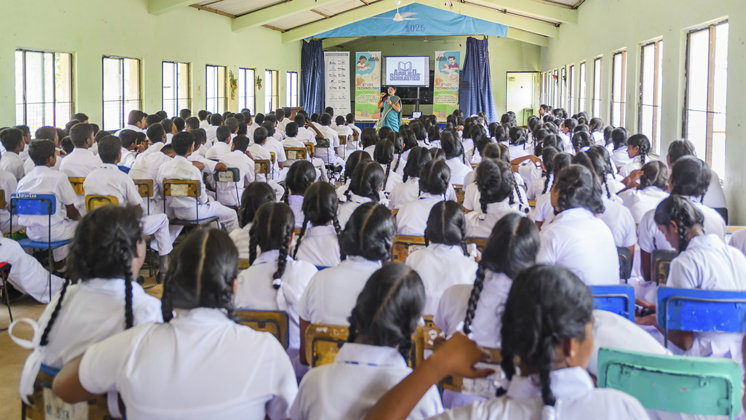
That mission is deeply personal. Born in Kandy, Sri Lanka, to an Indian father and Sri Lankan mother, Sundar grew up aware of the precarious status of Tamil plantation workers—descendants of Indian laborers who, for decades, were denied full citizenship and basic freedoms. “My heart goes out to them,” she said. “They don’t even know their basic human rights.” Her future plans center on bringing “Learning How to Learn” and reading programs to plantation schools across Sri Lanka, through coordination with the country’s Ministry of Education, beginning with large-scale student seminars already underway.
Asked what comes next, Sundar is unequivocal. “My institution will continue to train teachers in Study Tech and in the reading program, so that they can teach literacy at the grassroots level to have a direct impact on students,” she says. Scaling teacher training, she adds, is the priority “so that literacy can reach hundreds and thousands of students.”
Success, in Sundar’s definition, is shared rather than individual. “The biggest win for a teacher is not when one student gets 100 percent but when the whole class gets 100 percent,” she said. At the turn of a new year, her message to parents and educators remains simple and insistent: “Just believe that Study Tech works and try it out. You’ll see what a difference it makes when you change students’ lives.”
Backstage at the glittering New Year’s celebration, Sundar’s thoughts returned to the classroom. The applause mattered—not as a personal accolade, but as fuel. For an educator who left a system she could not defend, recognition now empowers her to build one worth defending—for teachers and students still waiting to discover how learning can belong to them.