

The ruling requires the agency to produce internal materials—including press releases, briefing records and other communications—that officials had previously withheld or heavily redacted in response to a Freedom of Information Act (FOIA) request filed by the Goldwater Institute, a Phoenix-based public policy organization.
The court found the department’s justifications for secrecy were inadequate under FOIA’s disclosure requirements.
FOIA lawsuits frequently serve as the vehicle through which government decision-making becomes visible, especially when agencies initially resist disclosure.
Beyond the dispute over one university, the decision underscores a broader legal principle: Federal agencies must provide clear and specific reasons when withholding public records, particularly when those documents concern major enforcement actions carried out in the name of the public. The court’s order therefore reinforces FOIA’s central purpose—to allow citizens and institutions to examine how government decisions are made.
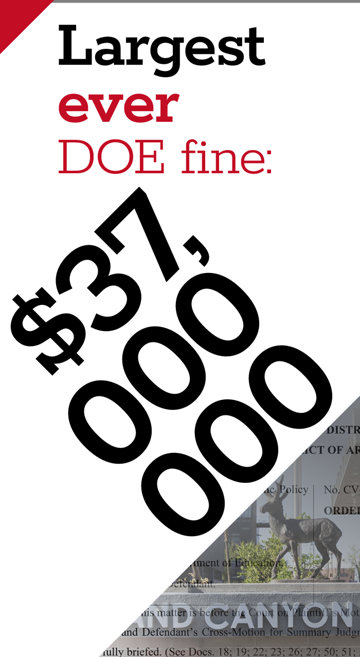
The records at issue relate to a penalty announced by the DOE in October 2023, when the agency imposed a $37.7 million fine on Grand Canyon University—by far the largest financial sanction ever issued against a US college by the department. Federal investigators alleged that the university misled doctoral students about the cost of completing dissertation requirements, claiming that advertised program prices understated the expenses many students ultimately incurred.
Department officials concluded the university had violated federal law by making “substantial misrepresentations” about doctoral program costs. According to the agency’s findings, fewer than 2 percent of students completed certain doctoral programs within the advertised price range, while most students were required to enroll in additional continuation courses to finish their dissertations.
Grand Canyon University strongly disputed those conclusions and appealed the sanction through the DOE’s administrative process. University officials maintained that their disclosures about doctoral program requirements were both lawful and common within higher education, arguing that continuation courses are a routine part of many doctoral programs nationwide.
The case took a dramatic turn in May 2025, when the DOE rescinded the proposed fine entirely. In a joint stipulation of dismissal order issued through the department’s Office of Hearings and Appeals, the agency ended the enforcement action “with no findings, fines, liabilities or penalties of any kind.”
Grand Canyon University President Brian Mueller described the decision as a confirmation of the institution’s long-standing position that the allegations lacked merit. “The facts clearly support our contention that we were wrongly accused of misleading our doctoral students and we appreciate the recognition that those accusations were without merit,” Mueller said in a statement announcing the dismissal.
But there were unanswered questions concerning how the DOE had reached the decision to impose such an unprecedented sanction in the first place. Seeking clarity, the Goldwater Institute filed a FOIA request for relevant communications and documents, including whether the department coordinated with other federal agencies before issuing the record fine.
FOIA requires federal agencies to respond to such requests within 20 business days. But, according to the institute, the department indicated it would take more than six months to provide records.
The Goldwater Institute subsequently filed a federal FOIA lawsuit, leading to the agency releasing heavily redacted records while withholding others.
The court has now found the agency’s explanations for withholding certain records legally insufficient and ordered that the department release internal press releases and briefing documents connected to the enforcement decision, which the judge determined the department never had any lawful basis to shield.
Transparency advocates say such rulings play a critical role in maintaining oversight of federal power. Enacted in 1966, the Freedom of Information Act establishes the public’s right to access government records, allowing journalists, researchers and citizens to examine how government decisions are made.
The law contains several exemptions designed to protect sensitive information—such as national security matters or personal privacy—but courts have repeatedly held that agencies must apply those exemptions narrowly and explain them with specificity. Vague or generalized claims of confidentiality won’t satisfy the law’s requirements.
The scale of the 2023 enforcement action and the later decision to withdraw it heightened interest in how the agency arrived at the record-setting fine—a process which may soon become visible through records the court has now ordered released.
Founded in 1949, Grand Canyon University has spent years defending its practices against federal scrutiny. Meanwhile, its critics, including some policy analysts and former students, maintain that the DOE’s original investigation uncovered significant evidence of misleading marketing practices. Litigation connected to those allegations continues in other forums, including a Federal Trade Commission lawsuit targeting an executive associated with the university and a related entity.
For transparency advocates, the case carries significance beyond the particulars of one institution’s regulatory battle. FOIA lawsuits frequently serve as the vehicle through which government decision-making becomes visible, especially when agencies initially resist disclosure.
By ordering the DOE to release records related to its unprecedented enforcement action, the court has reaffirmed a foundational principle of democratic governance: Policies and penalties imposed by federal agencies must withstand public scrutiny.
What emerges from the newly disclosed documents may clarify how the largest fine ever issued in American higher education unfolded. For now, the ruling stands as a reminder that the paper trail behind government power rarely disappears—it simply waits, sometimes through litigation, to be laid bare.