

“It is the public policy of this state that all persons … are entitled to full and complete information regarding the affairs of government and the official acts of those who represent them…. The people shall be informed so that they may fully participate in the democratic process.” —Michigan Freedom of Information Act
But according to a legal complaint brought by investigative journalist Charlie LeDuff against the office of Michigan Attorney General Dana Nessel, that promise is hollow.
Filed in the Michigan Court of Claims on December 19, the lawsuit challenges what LeDuff calls an unlawful and increasingly frequent maneuver by public agencies: granting FOIA requests on paper while withholding the requested records for months—or indefinitely.
“FOIA does not permit a public body to defer its legal obligations until some undefined future point of its choosing.”
The practice, known among transparency advocates as a “grant-and-delay,” allows agencies to claim compliance with the law while effectively denying access to public records.
According to LeDuff’s complaint, the grant-and-delay response “was not an aberration or clerical error; it was the execution of a deliberate departmental policy. That practice operates to delay disclosure, frustrate appeals, extract substantial fees without accountability, and deprive requesters of the procedural protections FOIA guarantees.”
The suit names the Michigan Department of Attorney General and seeks to halt the use of responses that “approve” FOIA requests without actually fulfilling them.
LeDuff’s case stems from a FOIA request he submitted in April 2025 seeking records related to Michigan’s response to federal COVID-19 inquiries, as well as conditions in public nursing homes. After invoking an extension, the Attorney General’s office replied that it would grant the request for any nonexempt records, without specifying what, if anything, would be released. The office then demanded a processing fee.
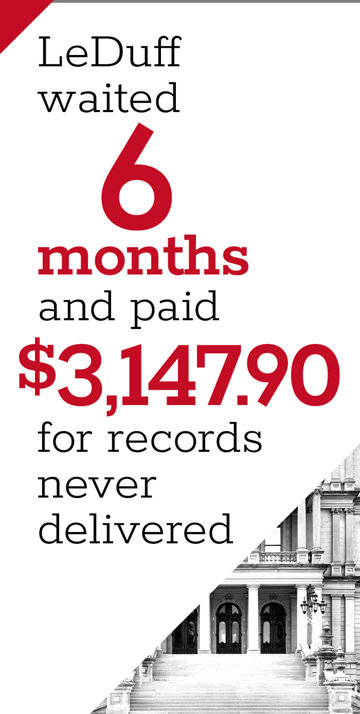
With no way of knowing whether the fee would cover 10 pages of records, 10,000 or none at all, LeDuff nevertheless paid the $3,147.90 in full.
Then, he waited.
Six months passed, during which he sent repeated follow-up correspondence and received assurances that production was forthcoming, including a letter arbitrarily extending the deadline yet again.
According to LeDuff’s complaint, “FOIA does not permit a public body to defer its legal obligations until some undefined future point of its choosing; nor does it permit an agency to condition lawful compliance on the requester’s payment of thousands of dollars while simultaneously withholding the very determinations the statute requires to be made promptly.”
At any rate, that second deadline, too, expired.
LeDuff’s experience isn’t an isolated breakdown but part of a broader pattern encountered by journalists, researchers and ordinary citizens across the state: approval without access, delay without end. Michigan’s FOIA has thereby become a locked door posing as a disclosure statute, double-bolted by whichever agency seeks to avoid public scrutiny.
In late December, Freedom reported on the state’s lengthy track record of stonewalling, including its automatic deletion of digital messages after 30 days. Michigan, moreover—unlike 48 other states—exempts its legislature and governor from all FOIA requests.
Years of lawmaker efforts to reform FOIA have crashed and burned against the stone wall—along with the state’s reputation for openness—as Michigan has failed multiple national ethics and transparency assessments. That includes a damning review by the Center for Public Integrity, which ranked Michigan dead last in anti-corruption.
After two measures to broaden Michigan’s FOIA sailed through the State Senate with only two dissenting votes, they’ve sat since January 2025 awaiting discussion. Meanwhile, Michigan Speaker of the House Matt Hall asserted he wouldn’t be putting the bills on the agenda.
“We’re just not going to do FOIA,” he said.
With so many other avenues having failed to enforce Michigan’s FOIA promise, perhaps a day in court might.
As Philip L. Ellison, principal attorney on the case, put it, “When an agency says ‘we grant your request’ but then produces nothing for half a year or more, that’s not transparency.”