

Whether eating grapes, burning effigies, jumping waves or banging bread, the moment carries a shared human impulse: to close one chapter and step deliberately into the next.
For many countries, the turning point arrives on January 1, a date so familiar it can feel inevitable. Yet the idea of a universal New Year is a historical construct, shaped by empire, religion and reform. The customs that surround it—culinary, communal and ritual—are far older and more diverse than the calendar that now unites them.
A Global Tapestry of Time
What binds these celebrations is not a single date but a shared belief that the first hours of a new year matter—that actions taken at the threshold of time may influence what follows.

The dominance of January 1 traces back to ancient Rome. Early Roman calendars began the year in March, but reforms attributed to King Numa Pompilius in the 7th century BCE added the months of January and February.
January was named after Janus, the two-faced god of beginnings, who looked backward and forward at once—a fitting symbol for a year’s end and start.
January 1 did not become the official Roman New Year until 153 BCE, and it was reinforced in 46 BCE under Julius Caesar’s Julian calendar.
After the Roman Empire’s fall, Christian Europe splintered the calendar again, observing the new year on dates tied to religious meaning, including March 25 and December 25.
The modern reset came in 1582, when Pope Gregory XIII introduced the Gregorian calendar to correct accumulated errors in leap year calculations. Catholic nations adopted it quickly; others followed over centuries, with Britain and its American colonies holding off until 1752.
Even today, January 1 is only one of many New Years. Religious and cultural calendars continue to mark renewal on other dates, from Rosh Hashanah in Judaism to Nowruz in Persian cultures and the Lunar New Year, widely celebrated across Asia.
Rituals of Renewal
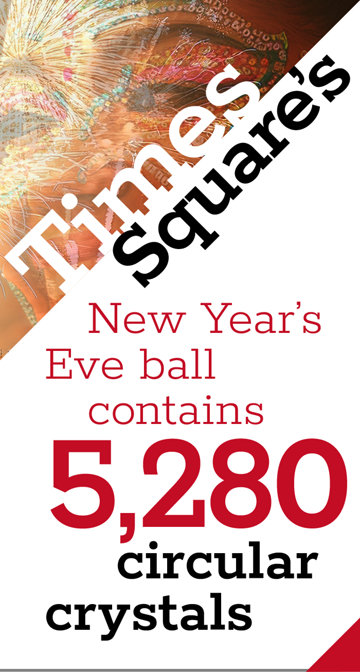
In the US, the most widely recognized New Year ritual unfolds in New York City’s Times Square, featuring an illuminated “time ball” that descends toward midnight. The tradition dates to 1907, when the first iron-and-wood sphere replaced the fireworks banned by city officials. Today’s globe, now containing 5,280 circular crystals and weighing over six tons, anchors a broadcast that attracts millions of viewers worldwide.
Across the continent, celebration often shifts from spectacle to sustenance. In the American South, black-eyed peas and collard greens are eaten on New Year’s Day to symbolize prosperity, while some households avoid chores like laundry for fear of washing away good fortune.
South of the US border, New Year customs lean heavily on symbolism.
In Colombia and Ecuador, revelers carry empty suitcases around the block to invite travel into the year ahead, while sawdust-stuffed effigies known as monigotes are set ablaze to purge negativity and bad memories. In coastal Brazil, celebrants dress in white, jump seven ocean waves and make offerings to Iemanjá, the Afro-Brazilian goddess of the sea, blending Catholic calendars with African spiritual traditions.
In Britain and Ireland, New Year traditions often center on the home. British households sing “Auld Lang Syne” at midnight and some observe first-footing, the belief that the first visitor to cross a threshold shapes the year’s luck. In Ireland, some families bang special bread against doors and walls to chase away bad spirits.
Scotland’s Hogmanay is more elemental: In parts of the northeast, revelers parade through streets swinging flaming fireballs, a ritual thought to cleanse the old year and light the way for the new.
Food anchors the holiday across much of continental Europe. French families gather for le réveillon de la Saint-Sylvestre, an elaborate late-night feast featuring oysters and other delicacies, while a German tradition is to eat pork and sauerkraut to invite good fortune. In Spain, the grape ritual, mirrored in Latin America’s custom, requires eaters to keep pace with the clock’s chimes.
Italy blends humor with symbolism. Red underwear is worn for luck, lentils are eaten for wealth, and in Bologna a papier-mâché effigy known as il Vecchione is burned in the city square to mark the year’s end. The act makes visible a shared desire to leave baggage behind.
Echoes of Ancestry
Eastern Europe is home to some of the most elaborate surviving ritual traditions. In Romania, performers don heavy bear skins for the annual Bear Dance, enacting death and rebirth through exhausting choreography rooted in pre-Christian mythology. Bulgarian families bake banitsa, a savory pastry with coins or paper fortunes tucked inside to forecast the year ahead.
In Japan, New Year—Shōgatsu—is among the most important holidays of the year. Families prepare osechi-ryōri, carefully arranged foods whose colors and shapes signify prosperity, health and longevity. Long soba noodles are eaten to symbolize endurance, while visits to shrines reinforce the spiritual dimension of renewal.
In the Southern Hemisphere, the New Year arrives in summer. Australia marks the moment with fireworks over Sydney Harbour, where light and sound dominate celebrations watched by millions worldwide. The display reflects a widespread belief that brightness and noise drive away evil spirits—a theme echoed across cultures.
A Shared Hope, a Different Midnight
Across continents and calendars, New Year celebrations reveal a paradox. They are intensely local—shaped by food, folklore and history—yet unified by a common logic. People clean, burn, eat, sing, smash, jump and toast because they believe the boundary between years is porous, a moment when intention can still tilt fate.
As the world enters another year marked by change and uncertainty, these rituals persist not because they promise certainty, but because they offer participation. They invite individuals into a collective pause, a brief agreement that time can be acknowledged, shaped and—if only symbolically—reset.
In that sense, the New Year is less a date than a practice. It is a global habit of hope, repeated annually, reminding societies how to look back honestly, step forward intentionally—and begin again.