

It was a democracy—one that had religious freedom writ large and bold in its constitution.
It was Japan.
“Religious freedom is a fundamental human right, and it must include the ability of communities of faith to exist, gather and practice their beliefs peacefully.”
On March 4, upholding a lower court’s decision, the Tokyo High Court ordered the immediate dissolution of the Family Federation for World Peace and Unification, more widely known as the Unification Church. The Church had committed no crime. Nevertheless, for what the court deemed “coercive tactics” to extract donations, it was found guilty of “significantly harming public welfare”—an accusation so vague and ill-defined it could be leveled at any faith community.
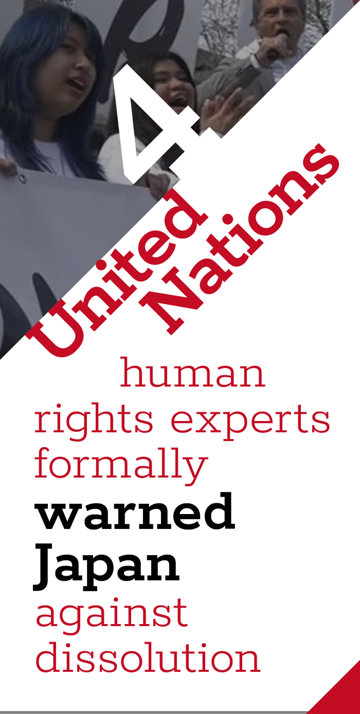
Indeed, “harming public welfare” as a standard for dissolution lies outside the permissible grounds for limiting religious liberty under the International Covenant on Civil and Political Rights (ICCPR), which Japan has signed and ratified. Last fall, four United Nations Special Rapporteurs—independent, highly specialized experts appointed by the UN Human Rights Council to monitor and report on global human rights issues—warned Japan against proceeding with the dissolution of the Unification Church (UC) on such grounds.
Their warnings were ignored.
Religious leaders, lawmakers and scholars worldwide reacted swiftly with outrage:
Former Secretary of State Mike Pompeo: “I worry this precedent will harm Japan’s standing as a champion of freedom in Asia and potentially advance the interests of those working against our mutual dedication to human dignity and religious freedom.”
Former US Ambassador-at-Large for International Religious Freedom Sam Brownback: “It is unbelievable that a democracy would dissolve a legitimate faith community that has not been convicted of a crime. This move by the Japanese government violates the Universal Declaration of Human Rights’ fundamental right to freedom of conscience.”
President of the Lantos Foundation for Human Rights and Justice Katrina Lantos Swett: “The decision … is completely out of step with what one would expect from a democracy that claims to uphold the fundamental right to freedom of religion or belief.”
For years, anti-religion interests had fought for the dissolution of the Unification Church in Japan, failing with each new attempt. Why did they succeed this time? What changed? Did the UC suddenly adopt “brainwashing” tactics, as alleged by the High Court? Did they engage in drug trafficking? Did they add human sacrifice to their church service?
No, the Church itself didn’t change—but the public mood did. The assassination of former prime minister and Church ally Shinzo Abe by a self-described victim, who claimed his mother’s donations to the religion destroyed his life, was the spark that lit the fuse.
He had been ruined. His mother was ruined. The family had all been ruined by the Unification Church. At least that was the story—but the story was a lie. In truth, the mother and her family were wealthy and remained so. At the Church’s insistence, she reluctantly accepted a refund of half the funds she had donated. No bankruptcy. No ruination. But the media pounced on the bogus story, extracting from it every ounce of sensation and prejudice they could.
In an emotionally charged climate, reason vanishes, replaced by pitchforks. Centuries ago, enraged villagers rampaged against witches. Today, witchcraft has been rebranded as “brainwashing”—a convenient idiocy leveled against too many new and minority religions. As attorney and sociologist of religion Massimo Introvigne points out, “Most scholars of new religious movements regard brainwashing theories as pseudoscience—no more respectable than insisting the Earth is flat. Courts in the United States and Europe have agreed. Yet in Japan, belief in mysterious mind‑control techniques remains stubbornly alive, a superstition with modern packaging.”
Now—as a consequence of rampant sensationalism and slander—thousands of parishioners who had prayed, gathered and raised their families together in faith found their houses of worship surrounded by police and liquidators.
“Religious freedom is a fundamental human right, and it must include the ability of communities of faith to exist, gather and practice their beliefs peacefully,” said the Reverend Demian Dunkley, president of the Family Federation for World Peace and Unification USA.
On March 19, some 500 people gathered at the Japanese embassy in Washington, DC, in a peaceful appeal for the protection of religious liberty.
“For our brothers and sisters in Japan, this moment has brought deep sorrow and uncertainty,” organizers said. “Communities that have served quietly and sacrificially for decades are now facing the sudden loss of their churches and places of worship.”
This is not the first time—nor, tragically, will it be the last—that a religion has been targeted simply for existing.
The bullet that felled Shinzo Abe was also aimed at the heart of a faith community of 600,000. Japanese courts, standing firmly on the wrong side of history, attempted to comply with his murderer’s wishes.
But hate has a curious way of backfiring on itself.
Rome tried to wipe out the early Christian church. Instead, Christianity became the world’s largest religion. Similarly, Muhammad’s enemies thought that banishing him from Mecca would end his movement. Islam flourished and now encompasses a quarter of the population of Earth. Scourges from Haman to Hitler did their bloodiest best to wipe out Judaism. They too failed, just as the Japanese government will fail in its crusade to eliminate the Unification Church.
As Introvigne observes: “Persecutors rarely win. They merely write the early chapters of stories that end with their own irrelevance.”