


In the fall of 2025, Liberterra III surpassed even that.
“We will be doing this again and again.”
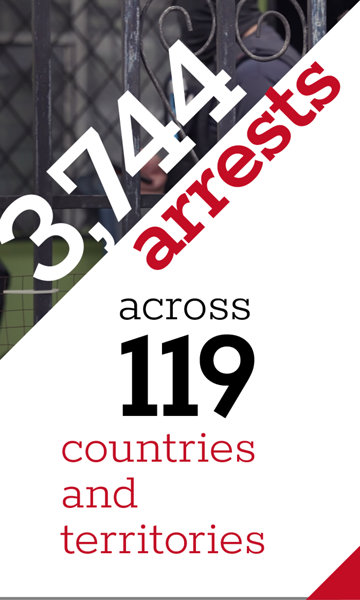
The global effort resulted in 3,744 arrests across 119 countries and territories. Working with nine law enforcement and operational partners, INTERPOL rescued 4,414 potential victims and opened more than 720 new investigations into criminal networks.
The organization announced the results of Operation Liberterra III on January 26, detailing how more than 14,000 officers carried out a coordinated global sweep of brothels disguised as beauty parlors, private homes, factories and other trafficking centers.
While the statistics are striking, the stories behind them reveal the human cost of the $236 billion-a-year criminal industry:
- In Mozambique, police liberated an eight-year-old boy who had been kidnapped to harvest his organs, a fate often amounting to a death sentence.
- In El Salvador, authorities saved a young girl “owned” by a 73-year-old man.
- In Belize, law enforcement officers freed children they discovered working under forced conditions at a glass factory.
- In Spain, authorities dismantled a ring exploiting 21 women, mostly Colombian. After luring their victims with job offers, traffickers coerced them into prostitution to repay so-called debts.
- And in West and Central Africa, enforcement actions against pyramid-style trafficking networks led to the rescue of more than 200 victims.
Beyond these individual rescues, the operation exposed a larger pattern: Like any multinational business, trafficking diversifies, while using the same illegal migration routes, and now includes the smuggling of other valuables besides human beings.
The operation also revealed new routes, critical intelligence on traffickers’ plans and the ever-expanding use of cyber technology by criminal networks.
“The level of enforcement action highlights strong cooperation, but the wider trends which have been revealed are just as important,” INTERPOL Secretary General Valdecy Urquiza stated. “Criminal networks are evolving, exploiting new routes, digital platforms and vulnerable populations. Identifying these patterns allows law enforcement to anticipate threats, disrupt networks earlier and better protect victims.”
But a single global operation won’t end the scourge of human trafficking. As one policeman put it, “We will be doing this again and again, ensuring that criminals ultimately face the justice that they need to, and that the people [who] need our protection—we will find them and we will protect them.”
So there will be many more Liberterras. Yet the willingness of nearly every nation on Earth to unite in a coordinated effort to halt the buying and selling of human flesh kindles hope—that the children rescued in Liberterra III may live to see an end to the trade in human beings.