

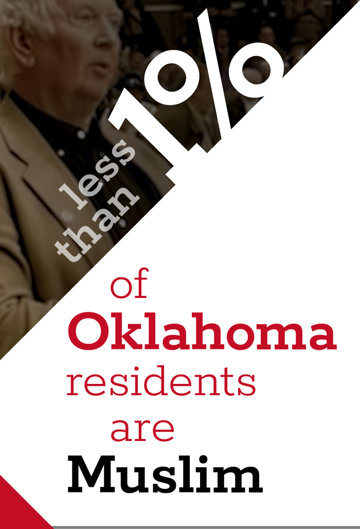
The city council of Broken Arrow, Oklahoma, a suburb of Tulsa with about 120,000 residents—68 percent white, in a state that is 70 percent Christian and less than 1 percent Muslim—went after that religious minority with unbridled animus.
That hostility became unmistakable when the Islamic Society of Tulsa (IST) submitted plans to build a 42,000-square-foot mosque and a 20,000-square-foot retail center on a 15-acre site they had owned since 2014.
The land had been zoned for agricultural use, and the Islamic Society of Tulsa requested that it be rezoned for commercial use.
“Not all Muslims are terrorists, but all terrorists are Muslim.”
After an explosive nearly four-hour city council meeting that drew over a thousand local residents, the council voted 4–1 to turn down IST’s rezoning request.
Those who spoke at the meeting made it abundantly clear that the problem wasn’t “zoning”—it was pure, unvarnished anti-Muslim bigotry.
“Not all Muslims are terrorists, but all terrorists are Muslim,” one said.
Others at the microphone intentionally mispronounced and poked fun at Arabic names.
“I don’t want somebody trying to behead me when suddenly there’s an Islamic majority,” said Chris Walsh, president of a local Christian ministry. “Islam doesn’t play well with others, and so I vehemently, on record, oppose the construction of a mosque in Broken Arrow, or anywhere in America for that matter.”
But in an attempt to avoid coming across as bigots, the council claimed their vote was based solely on city development concerns.
“The Broken Arrow City Council was abundantly clear in its decision to deny the application request for a rezoning and conditional use permit,” the council said. “The application was not approved due to the infrastructure needs surrounding the property.”
The city council’s argument is a little hard to swallow, considering that the Broken Arrow Planning Commission had recommended approval of the rezoning and issuance of a conditional use permit for the project well before the council meeting that rejected it.
To make matters worse, Attorney General Gentner Drummond announced that he intends to open an investigation into IST’s proposed project. His reasoning, at least, was refreshingly frank, if disturbingly discriminatory.
“Given the realities of global terrorism, there can be no compromise on public safety and security,” he said. “In our state, we have already seen a radical Islamist sentenced for plotting mass murder. Several 9/11 hijackers had attended an Oklahoma flight school. It is only appropriate to act with caution when the project in question might have connections to the Muslim Brotherhood.”
Oklahoma Senator Christi Gillespie said in a statement that the city council’s “decision reflects what many residents have been saying for years: The City of Broken Arrow must follow its Comprehensive Plan and protect long-term economic growth in our community.
“This proposal did not comply with the Comprehensive Plan’s clear designation of this corridor for commercial and employment-focused development, nor did it adequately address serious concerns related to infrastructure, traffic capacity, stormwater and floodplain management.”
Right—that’s one leg. Now, pull the other one.
“Religious freedom does not exist only when it is comfortable or popular; it exists for moments like this.”
“Zoning has long been used as a Trojan horse for discrimination, and what happened in Broken Arrow made that painfully clear,” the Tulsa County Democratic Party wrote in a statement. “Regardless of what you think of the merits of the infrastructure claims against the proposed Islamic mosque in Broken Arrow, it is a fact that the majority of the opposition’s concerns were overtly tied to the religion of the applicants.
“No one deserves that kind of treatment anywhere, let alone at a public meeting [run] by sitting elected officials.”
“The bottom line is that no public meeting should be allowed to be filled with such hatred directed at a specific community based on their religion,” said Sarah Gray, chairwoman of the Tulsa County Democratic Party.
“These are not terrorists, these are our community members. They are our doctors, they are our bankers, they’re our neighbors, parents.… I do want to encourage the Broken Arrow City Council and Mayor [Debra] Wimpee specifically to come out with statements denouncing the bigotry, denouncing the harmful comments, inciteful comments, that were made towards their own residents in Broken Arrow.”
The city council’s action may, in fact, have violated the federal Religious Land Use and Institutionalized Persons Act (RLUIPA), which protects religious exercise in land use decisions, including zoning and permits for places of worship.
“RLUIPA prohibits zoning and landmarking laws that substantially burden the religious exercise of churches or other religious assemblies or institutions absent the least restrictive means of furthering a compelling governmental interest,” the DOJ website states.
RLUIPA also bans actions that “treat churches or other religious assemblies or institutions on less than equal terms with nonreligious assemblies or institutions.”
IST has left no doubt that it intends to take the matter to court—and their case looks strong.
“IST intends to pursue all options to challenge and reverse this myopic and discriminatory decision through legal avenues, including a challenge brought under RLUIPA … which prohibits government entities and municipalities from imposing discriminatory or substantially burdensome land use regulations on religious institutions,” IST wrote.
“We are … disappointed that fearmongering and misinformation dominated the discourse around our proposal and that the Islamophobic frenzy on social media may have had an impact on the Council’s decision to deny our application.”
“I see a pattern in which people are being fed lies and misconceptions,” said Imad Enchassi, an Oklahoma City University religion professor. “It’s the same Islamophobia cycle that comes every once in a while.”
“We are asking nothing more than what this country [offers]—the freedom to worship peacefully and to continue positively in the community,” one meeting attendee said. “Religious freedom does not exist only when it is comfortable or popular; it exists for moments like this. Tonight is not just zoning, it is who we are as a community.… We are here to be good neighbors, to serve and to … reflect the values Broken Arrow stands for: fairness, inclusion and respect for the rule of law.”
If the city council thinks it can turn bias into governance, it seems it’s about to learn the hard way.
Here’s a tip for the council—believe what you want to believe and let others do the same. It might, in the long run, save you a whole heap of trouble.