

Houses of worship are meant to be refuges—places of prayer, reflection and peace—not stages for intimidation and abuse.
Yet across the country, agitators have turned religious observance into an opportunity for harassment—armed with loudspeakers, shrieks and hateful signs, they target families, children and faith communities as they arrive to pray.
And they leave suffering and dismay in their slimy wakes.
But one area of New York is finally doing something about it.
“Everyone deserves to attend religious services without fear or intimidation.”
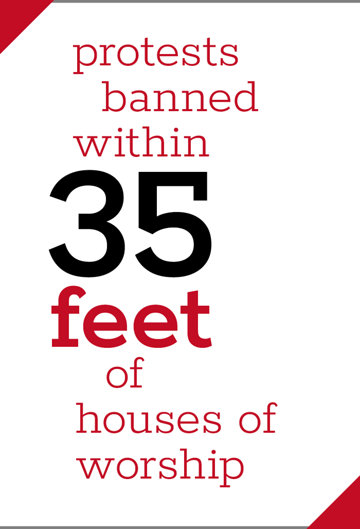
The Nassau County legislature has now passed the Religious Safety Act to protect people of faith, banning demonstrations within 35 feet of entrances to places of worship for an hour before and an hour after religious services.
The new law, which passed unanimously, has real teeth—violate it, and protesters could face a year in jail, a $250 fine, or both.
“Everyone deserves to attend religious services without fear or intimidation,” said Nassau County legislator James D. Kennedy. “Today, we made the Religious Safety Act a reality.”
The new law bears several similarities to the federal Freedom of Access to Clinic Entrances Act of 1994, which combines protection both for those using abortion clinics and places of religious worship. But the Nassau County action provides more specific prohibitions in terms of distance from religious worshippers and times when the law comes into play.
“People of all religions should be able to gather in practice and safety,” said Rabbi Steven Saks of Congregation Sons of Israel. “As long as people are engaged in peaceful practice of religion, it’s important that they are protected.”
At a recent protest at Manhattan’s Park East Synagogue, protesters shouted inflammatory slogans at worshippers as they entered. That and the terror attacks against Jews at Bondi Beach in Australia, killing 15, inspired passage of the new Nassau County law.
“Our synagogue has twice been targeted by … bigots who threatened our community,” Rabbi Ya’akov Trump of Young Israel of Lawrence-Cedarhurst said. “No religious community should be allowed to be targeted like this.”
Churches of Scientology, too, have been subjected to harassment by anti-religious hate groups seeking to intimidate and impede parishioners on their way to and from religious services.
“This measure does not silence anyone,” New York State Assemblyman Ari Brown said of a similar state-level initiative introduced in early December. “It simply says you don’t get to target families, children or religious communities at their most vulnerable.”
“Public safety means protecting people where they live and where they pray.”
Assemblyman Micah Lasher emphasized that the state legislation preserves First Amendment rights while setting basic boundaries. “We are not saying you can’t protest. We’re not even saying you can’t protest around a house of worship. We are saying there needs to be some reasonable space so that people who are trying to enter a house of worship … can do so without having to run a gauntlet.”
“Freedom of worship is not negotiable,” said Nassau County Executive Bruce Blakeman. “In Nassau County, we made it clear that intimidation and interference will not be tolerated. Public safety means protecting people where they live and where they pray.”
The law applies not just to synagogues but to all houses of worship.
“The free exercise of religion is among the most fundamental of human rights, granted to us by God,” said Father Eric Fasano of the Catholic Diocese of Rockville Centre. “The Church is grateful for any opportunity to support and highlight that right. All people should feel safe to attend religious services without fear of intimidation or hindrance.”
The law’s unanimous passage sends a clear message: Protecting people of every faith from attack while practicing their religion is a matter of basic decency and common sense.
There’s only one problem: Nassau County is just one county.
Such protections should be the rule everywhere—not the exception.