

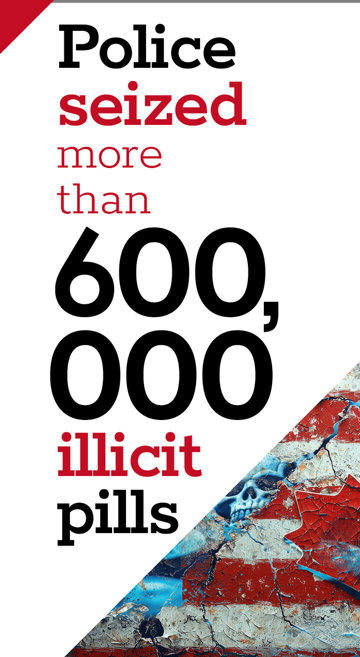
Police seized over 600,000 illicit tablets. The haul included 288,000 metonitazene pills, 128,000 methamphetamine tablets, 180,000 benzodiazepine tablets, 10,000 MDMA tablets and 81 liters of liquid protonitazene, along with marijuana and cocaine.
“Metonitazene and protonitazene are substances not widely known to the public at present, but they are considered more potent than fentanyl,” Quebec police said.
These are the drugs slaughtering Americans.
“Non-Mexican drug trafficking organizations in Canada are very likely picking up the slack and fulfilling the demand in the US.”
Police arrested dealers Darren McAlpine of Delson, Geneva Fournier of Châteauguay, and Wanya Nathan Ellis and Cheyanne Buchanan-Dennis, both of Sainte-Catherine. They now face charges including possession for the purpose of trafficking, drug trafficking and possession of a prohibited weapon.
In the past, China supplied the precursor chemicals that were converted into highly lethal narcotics in underground laboratories, often in Mexico, before being shipped into the US.
Today, as cartel leaders have been arrested or extradited to US custody and the deaths of key figures have weakened Mexican cartels’ grip on the drug trade, Canada has emerged as a major player. Canadian biker gangs, Iranian organized crime groups, and street gangs like Zone 43 and the Wolfpack—linked to Mexico’s Sinaloa Cartel and the US Crips—have joined forces, creating a new, highly cooperative network for drug production and distribution.
This makes them far harder to stop, with police on both sides of the border scrambling to keep up.
A Falkland “superlab,” a major drug production hub in British Columbia, now receives Chinese precursor chemicals and manufactures lethal drugs like fentanyl, carfentanil and nitazenes—in cooperation, not competition, with Mexican cartels.
And these are devastatingly powerful substances: Fentanyl is 50 times more potent than heroin, while carfentanil, an elephant tranquilizer, is 100 times stronger than fentanyl.
“Non-Mexican drug trafficking organizations in Canada are very likely picking up the slack and fulfilling the demand in the US, as addicts and local distributors are looking online,” said Don Im, a former senior agent in the DEA’s Special Operations Division.
What America now faces, according to Im, is “the most deadly form of slow-motion weapon of mass destruction”—a deadly mix of Chinese precursor chemicals, Mexican cartel and street gang distribution networks, and dark web and social media online marketplaces for drug sales.
The Montreal raid was a major win, no doubt. But cut off the heads of the snakes dealing these murderous drugs, and the profits waiting at the other end ensure that new heads will quickly sprout to take their place.
Yes, police seized a massive haul of illicit and potentially lethal drugs. But for dealers, losses like that are now just a minor cost of doing business. Catch one shipment, and chances are you missed the last 10—and the next 10. They’ll simply churn out more of their deadly product in secret labs, ready to ship and sell again, with barely a hiccup in the supply chain.
We keep hearing it all the time: Top narcotics officers round up a mob of drug peddlers, lock them up and seize a ton of drugs.
Hooray! Then what?
Did they take all the drugs off the streets? Aren’t dealers still selling, and addicts still dying, no matter how many arrests are made or shipments destroyed?
Aren’t we all getting tired of the same old cycle, with arrests and seizures barely scratching the surface of the drug crisis devastating our communities?
It seems there’s no end in sight to the “war on drugs.”
What’s truly most disturbing about the four Canadian arrests is what they reveal: Drug dealers today operate as highly successful, multinational networks. Stopping them requires massive, coordinated efforts from law enforcement across multiple countries, and even then, the impact is often just a small dent in their operations. These networks are resilient and agile, able to shift production and distribution on a moment’s notice, staying one step ahead of the authorities.
It’s reminiscent of the days of Lucky Luciano, who in the early 1930s took control of and reorganized the national crime syndicate La Cosa Nostra. By getting rival Mafia families to cooperate rather than fight, Luciano vastly increased their profits and strengthened their organization—a blueprint for efficiency and resilience that, disturbingly, mirrors how today’s drug networks operate.
Today, drug manufacturers and dealers have gone corporate, operating like Amazon or Walmart, using the same business strategies and merger techniques that let them survive and thrive—far stronger than most police departments, stronger than anti-drug organizations, and certainly stronger than our too often feeble attempts to stop them.
Luis Nájera, coauthor of The Wolfpack: The Millennial Mobsters Who Brought Chaos and the Cartels to the Canadian Underworld, said Canadian criminal influence on international drug trafficking has grown significantly. “I would say it has increased since criminal cells moved up north to settle and expand operations here,” Nájera explained.
“It is also strategic to have groups operating north of the US border, close to key places such as Chicago and New York, and without the scrutiny of the DEA and rival groups.”
They have grown so large that they are virtually unstoppable, at least if we keep going after them in the same old way, with law enforcement.
But there is reason for hope. The one common element in all of this—the vulnerability of even the most powerful drug networks—is the market itself: drug users.
And that is precisely where the drug pushers can be stopped—their one true weakness. If Americans stop buying, the nation’s drug problem will come to a screeching halt.
So far, the most effective tool for limiting the demand for drugs, and the most effective weapon against worldwide drug pushers, is one simple, undeniable lever: the truth.
The Foundation for a Drug-Free World has published 15 booklets—one on each of the most commonly abused drugs—with the most recent telling the truth about fentanyl.
A nonprofit sponsored by the Church of Scientology, the Foundation delivers the world’s largest nongovernmental drug prevention program. To date, it has distributed more than 170 million of its Truth About Drugs booklets, educating people in 20 languages across every nation of Earth.
The booklets present straight facts rather than lectures or moralizing—laying out plainly how drug use can lead to devastation and, all too often, an early grave.
They hold the key to stopping the international drug trade, by removing the very thing that keeps it thriving—demand.
Young people need to learn the unvarnished truth about drugs before they foolishly take their first puff of marijuana, their first sniff of cocaine or their first swallow of an opioid pill.
They need to know that misstep is the first one on the road to death.
If they grasp the facts, we can break the demand for these lethal, illicit drugs—at which point the drug trade itself collapses.
It can be done. We must do it. And we will.