

What terrible secret or secrets are they so desperately trying to hide?
And just how desperate are they?
Desperate enough to fire Connie Clay, the city’s former Freedom of Information Act (FOIA) officer, because—she alleges—she complained about officials ducking their legal responsibilities under the FOIA, and because she refused to lie about the city’s response to a records request from a local reporter.
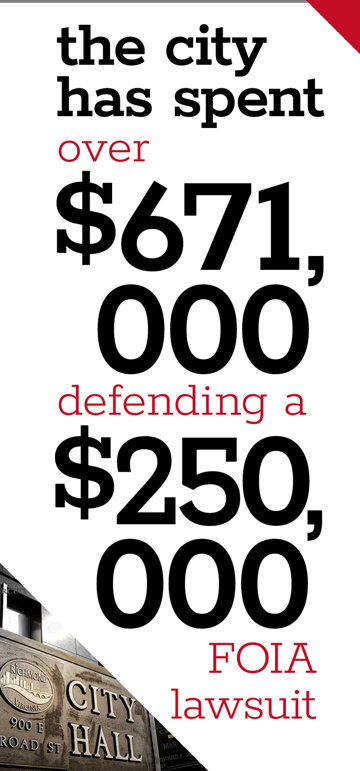
Desperate enough that the city stumbled into a $250,000 whistleblower retaliation and wrongful termination lawsuit filed by Clay, alleging it repeatedly ignored or delayed FOIA requests—and has already spent over $671,000 defending the case, nearly three times what she initially sought.
And desperate enough that the city’s attorneys have asked the court to stop Clay from filing her own FOIA requests because those requests could allow Clay to “gain improper insight into the city’s case strategy and secure an unfair tactical advantage.”
They also want the court to order Clay to stop speaking to the press about her case.
“Ask anybody in every state whether people comply with [FOIA] law all the time and it’s pretty discouraging.”
Freedom Magazine first reported on Clay’s lawsuit in August 2025, documenting her allegations of retaliation and the city’s repeated FOIA violations. Since then, new developments have only deepened questions about the city’s transparency.
Oddly enough, after the defense provided a cellphone belonging to Petula Burks, former city spokeswoman and a defendant in Clay’s case, it became clear that the phone was a replacement for Burks’ original city-issued device, which the city says had been lost.
That replacement phone contained very few text messages—and none of them were related to Clay’s firing. Clay was hired in July 2023 and fired in January 2024; the city claims Burks’ original phone went missing during air travel in the summer of 2024.
The issue only came to light after the judge personally searched Burks’ phone, only to discover it was the barely used replacement Burks received shortly before leaving her job. Burks’ original phone had been subject to a “litigation hold,” but any information on it is now presumed lost.
Clay’s attorneys believe that original phone could have contained texts crucial to her case.
And the question nobody wants to answer is whether Burks really lost the phone, or whether the phone contained messages so damaging to the city’s case that the attorneys decided to pull the old switcheroo and disappear that phone for good.
Circuit Judge Claire G. Cardwell expressed her frustration sharply. “At no time in all of these hearings … did you tell me, ‘Judge, you’re looking at the wrong phone. You’re looking at a phone that has nothing to do with this case,’” she admonished the city’s lawyers.
Cardwell said the telephone dispute showed “a general lack of respect for the Court’s orders” and added, “The Court still has not received a complete, consistent and definitive story regarding how exactly the phone was lost, where it was lost, when precisely it was lost and where it is now.”
She termed the phone she had been given “completely irrelevant” to the lawsuit being heard.
On the question of compliance with FOIA laws, Megan Rhyne, director of the Virginia Coalition for Open Government, agreed that Clay had trouble getting Richmond city officials to cooperate and obey the law.
“People were resistant in one way or another,” she told Freedom Magazine. “Ask anybody in every state whether people comply with [FOIA] law all the time and it’s pretty discouraging.”
Clay stated, “There were many instances where I was asked to withhold information that should have been released.”
She maintains she lost her job because of her “whistleblowing about the city’s ongoing FOIA violations and lack of transparency” and as “retaliation for reporting and refusing to engage in illegal and unethical activities in violation of FOIA.”
Clay points to many instances where she found Richmond officials uncooperative about releasing information, including casino proposals, the mayor’s salary and meals tax procedure from the city’s finance department.
Clay said she hopes that her lawsuit will embolden average citizens to demand the truth from their government.
“You pay the salaries of everyone in City Hall, from the janitor on up to the mayor. You pay their salaries and they should report to you.… I hope they will realize that you can fight City Hall, that you can stand up for your rights, that you must stand up for your rights.”
Burks said in a deposition that Clay had “sort of a bitchiness type of attitude,” and had such a “dogged persistence” in meeting FOIA deadlines that some administration officials wanted her gone.
Under Virginia law, when a FOIA request is filed, agencies have five days to respond or to request a seven-day extension. However, Clay said these requirements were routinely delayed or ignored.
“I sounded the alarm for several months, and no one listened, and I was silenced and then fired,” Clay said. “It’s just such a huge disappointment that the bureaucrats in City Hall do not want to follow the law. And if I don’t say something, who will?”
The Church of Scientology has been one of FOIA’s oldest and fiercest advocates. It has a long and proud history of taking government agencies to task that are attempting to withhold information from the public, while forcing the burden of proof onto those agencies to demonstrate why they are refusing to provide allowable information.
There’s a lot at stake in these cases, including the need for citizens in a democracy to know the truth in order to properly and intelligently cast their votes.
As Scientology Founder L. Ron Hubbard wrote, “Democracy depends exclusively on the informedness of the individual citizen.”
Richmond voters and taxpayers deserve an answer to this question: Exactly what are their government bureaucrats trying to hide?
There’s just too much smoke for there not to be a blazing fire somewhere.