

On December 10, Human Rights Day, officials at United Nations Headquarters will invoke the Universal Declaration of Human Rights. They will praise “dignity and worth,” condemn “hatred and intolerance,” and reaffirm every person’s right to “freedom of thought, conscience and religion.”
And somewhere in that same system, a longtime UN staff member who worked in the Ethics Office will go back to her desk—still on the payroll, still protected by the blue flag—after years of posting bigoted rants, applauding cyber-mobs, and openly proposing the use of repressive governments and far-right politicians to target believers of every stripe.
Her name is Arielle Silverstein.
“We can totally use the Pakistani government’s religious intolerance against Scientology.”
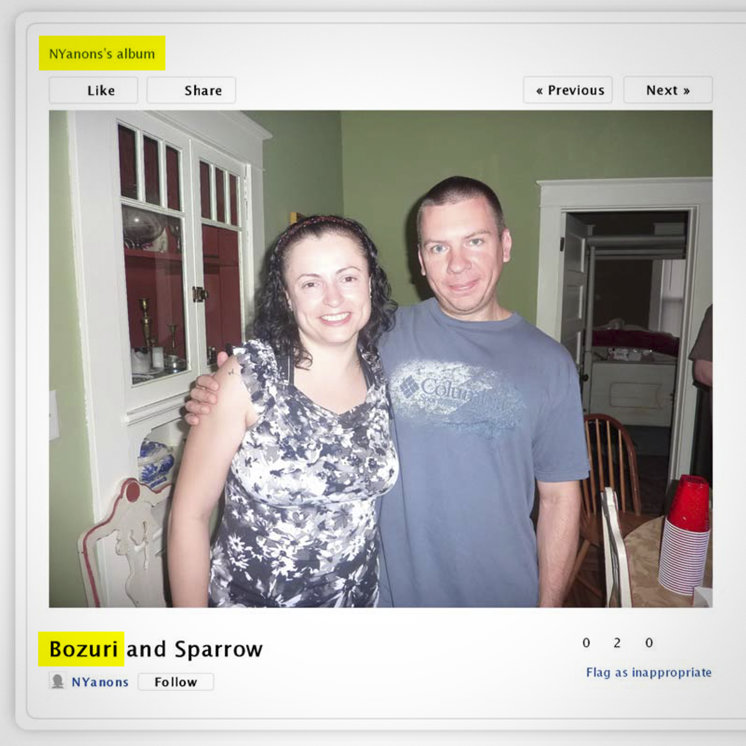
According to her own public profiles, Silverstein is a lawyer educated at the Netherlands-based Leiden University who has held posts in the UN’s Department of Management Strategy, Policy & Compliance and previously in the Management Evaluation Unit—the office that reviews discipline for UN staff—as well as the UN Ethics Office. Behind the keyboard, she has used aliases such as “Bozuri” and “Arielle Sarai” to scatter the internet with anti-religious screeds attacking Muslims, Jews, Christians and Scientologists, all while drawing a six-figure salary from an organization that demands its staff “shall not discriminate against any individual or group.”
Her own postings show how thoroughly she ignored that standard. She called Christians “suckers” for believing in martyrdom. She mocked the Prophet Muhammad as an “illiterate desert dweller” and jeered that Muslims were “particularly thin-skinned.” She described “Arab men” as “Neanderthals” who “think that the husband is always right and that they are allowed to beat up the woman.” She wrote that her “dislike” of ultra-Orthodox Jews was so great she “refused to work with them on anything” and declared that she wanted the Simon Wiesenthal Center—a Jewish human rights institution named after a Nazi hunter—to “cease to exist.”
On a day when the UN congratulates itself for defending human rights, Freedom asks a simple question: Why is a UN ethics insider allowed to mock believers, cheer on cyber-harassment, and openly propose using repressive governments and demagogues to persecute a minority faith—and still keep her badge?
As the saying goes, when organizations say one thing and do another, trust what they do, not what they say. And what has the United Nations done about Arielle Silverstein? Nothing at all.
But the UN’s own staff regulations are unambiguous.
Staff members, they state, “shall uphold and respect the principles set out in the Charter, including faith in fundamental human rights, in the dignity and worth of the human person” and “shall exhibit respect for all cultures; they shall not discriminate against any individual or group of individuals.” They must avoid “any kind of public pronouncement that may adversely reflect on their status, or on the integrity, independence and impartiality that are required by that status.”
Every UN staffer, on appointment, signs a declaration promising to “exercise in all loyalty, discretion and conscience the functions entrusted to me” and to “regulate my conduct with the interests of the United Nations only in view.”
Silverstein, by all appearances, signed that. Then, under her online personas, she did something else entirely.
Among her most brazen displays of contempt was her celebration of “Everybody Draw Mohammed Day,” an internet campaign designed explicitly to provoke and humiliate Muslims by encouraging depictions of the Prophet Muhammad—an act considered deeply offensive across the Islamic world. At 11:49 a.m. on Tuesday, May 15, 2012—squarely within UN work hours—Silverstein tweeted under an alias that she was “planning on committing the crime of blasphemy on #MohammedDay” and gloated that it was “good not to be living in Kuwait, Afghanistan or Saudi Arabia.” For a UN official—someone duty-bound to respect cultures and avoid inflaming religious tensions—this was not just inappropriate. It was incendiary.
And when it came to Scientologists, her rhetoric crossed another line: from mockery to explicit strategies for state-backed persecution.
In 2011, posting as “Bozuri,” Silverstein turned her attention to Pakistan. She wrote that the Pakistani government “really dislikes not only proselytism” but discriminates against its own non-Muslim citizens. That discrimination, she admitted, is “outrageous.”
Then came the turn.
“But we can totally use the Pakistani government’s religious intolerance against Scientology,” she wrote, suggesting that rather than contact “extremists,” critics of Scientology could rely on the Pakistani state itself, which she described as “one and the same” with those radicals.
At the time, human rights bodies were already documenting Pakistan’s blasphemy laws as a machinery of persecution: Christians and other minorities jailed or killed over accusations, prisoners dying in custody, death sentences for alleged text messages. The US Commission on International Religious Freedom had recommended—again—that Pakistan be designated a “Country of Particular Concern” for “systematic, ongoing, and egregious violations of freedom of religion or belief.”
Silverstein’s response was not to oppose that repression, but to weaponize it.
For a UN staff member—let alone one who worked in the Ethics Office—to advocate exploiting a government’s human rights abuses against a minority faith is not a lapse in judgment. It is a direct collision with the UN’s own mandate to protect freedom of religion or belief.
If Pakistan’s blasphemy laws were one tool, far-right Dutch politician Geert Wilders was another.
In 2012, again posting as “Bozuri,” Silverstein advised a contact in the Netherlands on how to get Wilders—a peroxide-blond nationalist known worldwide for his anti-Islam crusades—to move against Scientologists.
“Seriously—get Gert [sic] Wilders to f—k with them,” she urged. “That bleeched blond dude will expel their assess [sic] out of Holland, as if they were illegal aliens.”
She then suggested a talking point to grab Wilders’ attention: “Tell Wilders about Scientology’s ties to the radical Muslim [LOL].”
Her correspondent later replied that “the entire parliamentary PVV [Wilders’ far-right Dutch party] group has received an email, including your blond friend.”
In other words, a UN staffer who has worked in ethics and management oversight encourages the use of an anti-Islam populist’s xenophobia and anti-immigrant rhetoric to have Scientologists treated “as if they were illegal aliens”—in a country where the Church of Scientology is recognized as a religion and operates as a nonprofit, with rights affirmed in court.
This is not “free speech.” It is targeted political agitation that seeks to strip a minority faith of legal protections and residency, by piggybacking on an already stigmatized group (Islam). It is the opposite of what the UN says it exists to prevent.
Silverstein’s contempt for believers didn’t end at the keyboard. It spilled over onto the street—and into the masked cyber-mobs who converted harassment into a brand.
Silverstein is an avowed member of Anonymous, the loose network of internet criminals whose own video once boasted: “We ruin the lives of other people simply because we can.” On message boards tied to anti-Scientology Anonymous operations, Silverstein—again as “Bozuri”—cheered on New York “anons” who staged obscene protests outside Churches, described how she loved their videos that made her “laugh, gag and blush all at the same time,” and urged people to send money to an Anonymous member repeatedly arrested for criminal acts.
Her posts revel in Anonymous’ “vigilantes” taking “vengeance on hated institutions.” She ridicules Scientologists as “lunatics,” and while she occasionally scolds fellow anons for being too juvenile in their taunts, her objection is purely tactical, not moral: She thinks nastier tactics delivered with a different tone would land harder.
This is the group whose message boards have hosted racist slogans like, “Around blacks never relax” and “With Jews you lose,” and even offered instructions on how to commit suicide, complete with graphic images of where to slit your own wrists.
Human rights do not become universal because they are read from a podium one day a year. They become universal when institutions enforce them.
The UN Ethics Office guide, by contrast, instructs staff to “put ethics to work” by avoiding any conduct that could be seen as harassment or discrimination and to “refrain from any action which might reflect negatively on their position as United Nations personnel.”
How does a staff member who funds, praises and participates in Anonymous’ campaigns against religious minorities meet that standard?
It is worth noting that the Church of Scientology sponsors the world’s largest nongovernmental human rights education initiative dedicated solely to the UN’s own Universal Declaration of Human Rights. Through free booklets, PSAs, posters and a full educator curriculum available in 17 languages, the program has reached more than 70 million people.
And this is the community a UN “ethics” insider feels emboldened to mock, target and treat as disposable?
Silverstein’s anti-religious influence doesn’t stop with her own posts. It also flows through her bank account.
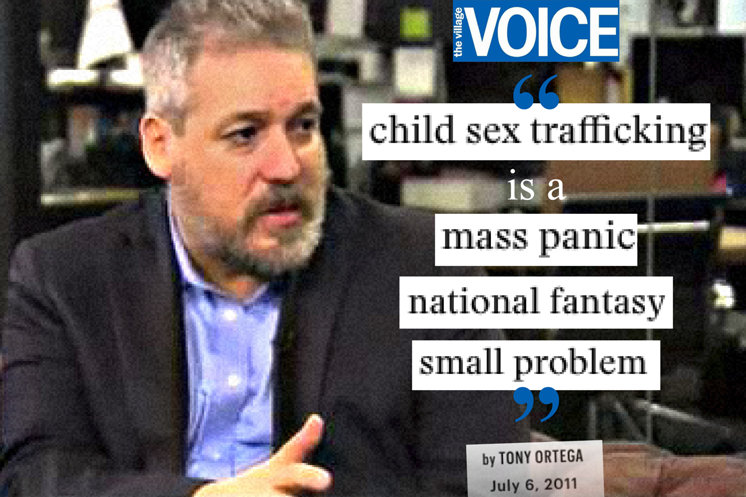
Her husband, Tony Ortega, is a professional anti-Scientology hate blogger and disgraced former editor of The Village Voice, then under Village Voice Media—the utterly shameless owner of Backpage.com, later described by law enforcement and a US Senate subcommittee as the world’s largest online marketplace for child sex trafficking.
During Ortega’s years at the Voice, he became Backpage’s loudest public defender, deriding concern about child sex trafficking as a “national fantasy” and “mass panic” over a “nonexistent epidemic of sexual slavery.” As revealed in federal investigations and court proceedings, underage girls were being bought and sold on the site, then raped and, in some cases, murdered.
In August 2024, Backpage co-founder Michael Lacey—Ortega’s former boss—was sentenced to five years in federal prison, while executives Scott Spear and John Brunst received 10 years each on money laundering and prostitution facilitation charges related to sexual exploitation.
Throughout, Silverstein has used her UN salary to support Ortega. His own attorney once called her “a power behind the throne … his tireless researcher and significant other, Arielle.” In online forums, she defended prostitution as something that “should be legal” and dismissed criticism of Backpage-type business models by saying: “Of course it’s about money. But it doesn’t make it illegal or wrong.”
The UN cannot control whom its staff marry. But it can control whether a senior employee who funnels UN paychecks into a full-time campaign of religious harassment—and into the enabling of a man who publicly minimized the harms of an online marketplace for trafficked women and children—meets its test of “integrity.”
Silverstein often wraps her bigotry in the language of secularism. She calls herself a “Jewish heretic” and an “atheist Jew.” She posts that “all religions are a joke,” advocates “less religion,” and says she “likes nothing more than explaining to religious people why I dislike God.”
In a genuinely pluralist society, atheism is one acceptable choice among many. Freedom of religion includes the freedom not to believe.
But the UN is not employing Silverstein as a private citizen who has a personal viewpoint. It is employing her as an international civil servant bound to uphold the rights of believers and non-believers alike, without discrimination.
And her attacks go far beyond personal critique of dogma. After all, they portray Muslims as violent, “thin-skinned” and “sexually repressed,” “Arab men” as wife beaters, Christians as dupes, ultra-Orthodox Jews as a “cult,” and Scientologists as “nutters” whose presence in government should be prevented by barring them from office.
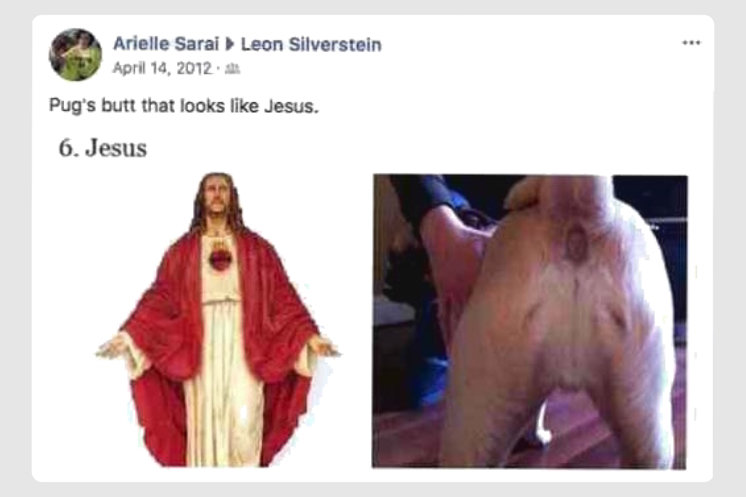
If any other UN staffer had posted such material about a racial or ethnic minority, their career would likely be over. The fact that Silverstein’s targets include Muslims, Jews, Christians and Scientologists makes the UN’s silence more striking, not less.
On Human Rights Day, the UN will once again stage its rituals of self-affirmation. It will remind the world that Article 18 of the Universal Declaration guarantees everyone the right “to freedom of thought, conscience and religion,” including the right “to manifest [one’s] religion or belief in teaching, practice, worship and observance.”
It will repeat that human rights are “universal, indivisible and interdependent.” That they are not reserved for majorities or for fashionable causes, but for every individual—especially minorities who are easy to hate and safe to ignore.
But in offices and message boards and social media feeds, a different UN is on display: one that looks the other way as an insider in its own ethics and management ranks mocks believers, aligns with cyber-thugs, and openly strategizes how to harness repressive regimes and far-right demagogues to drive a minority religion from public life.
The UN has chosen to promulgate staff regulations for a reason: to draw a bright line between private opinion and public conduct incompatible with its mission.
The question raised by Arielle Silverstein is not whether the UN has good language on paper. It is whether those words mean anything when they collide with the prejudices of its own people.
Human rights do not become universal because they are read from a podium one day a year. They become universal when institutions enforce them, even—or especially—when the violator wears their own badge.
Until the United Nations is willing to confront the hate on its own payroll, its Human Rights Day proclamations will remain just that: proclamations. The real test of its commitment lies not in the resolutions it passes, but in the bigots it is willing to cast out.