

That leap first came in the form of Thomas Jefferson’s Virginia Statute for Religious Freedom—the basis for our most sacred right, as crystallized in the First Amendment. The Statute was enacted on January 16, 1786, a date now celebrated as National Religious Freedom Day. That anniversary served as the backdrop for the release of the Becket Fund for Religious Liberty’s annual Religious Freedom Index.
Perhaps most striking, the Index found strong support for religious freedom across every generation, very much including Gen Z.
A yardstick measuring America’s support of religious freedom, this year’s Index reports the highest overall score to date—at 71 on a 0-to-100 scale, based on a nationally representative survey of 1,000 American adults.
According to the Becket Fund, although Americans may disagree on many other issues, “this year’s Index findings show that they rally together in support of religious freedom.”
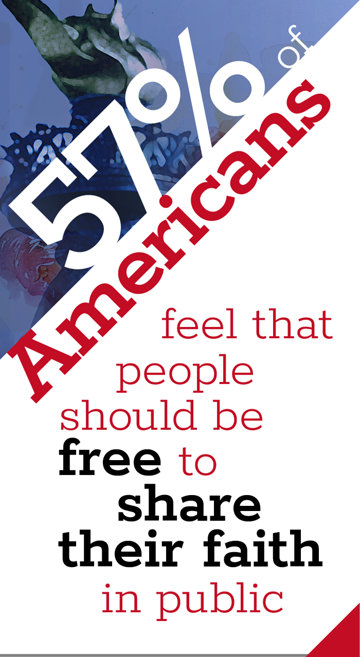
The Index further reveals a clear shift in public sentiment in recent years: A growing majority of Americans now view religious freedom as something meant to be lived openly, not just practiced privately and discreetly. Fifty-seven percent say people should be free to share their faith in public spaces, a five-point increase since 2020. And support for parental authority is rising even faster, with 73 percent agreeing that parents should be able to opt their children out of public school material they find inappropriate, including that which conflicts with their religious beliefs—a 10-point jump in the last five years.
That support extends to the judicial sphere. The survey shows broad public backing for recent Supreme Court rulings on religious liberty, including 62 percent support for Mahmoud v. Taylor—affirming parental rights in guiding a child’s religious upbringing—and 65 percent support for Catholic Charities Bureau v. Wisconsin, which paved the way for exemption from state unemployment tax for faith-based organizations, including those serving individuals who are not members of their own faith.
Americans are also protective of—and resistant to government intrusion into—religious practice itself. Sixty-one percent oppose state laws that would require priests to break the confidentiality of confession, while 75 percent favor public funding that allows parents to choose religious schools, an issue now at the center of St. Mary Catholic Parish v. Roy. The case takes to task a Colorado “universal” preschool program that claims to fund 15 hours per week of free preschooling for all kids in the state, while excluding religious schools from the program.
Perhaps most striking, the Index found strong support for religious freedom across every generation, very much including Gen Z—once again debunking the myth that commitment to religious liberty is fading among young Americans.
“Americans,” the Index authors conclude, “are moving away from a timid, behind-closed-doors view of religious freedom and toward a conception that empowers individuals to pursue happiness according to their faith, at home, at church, at school and in the public square.”
All in all, the 2025 Index demonstrates that what was, over two centuries ago, a radical experiment has now firmly taken root—no longer a fragile principle whispered behind closed doors but a living liberty exercised in the open.
Jefferson knew he had done something momentous that day, nearly a quarter of a millennium ago, by setting down the principle of religious freedom. He directed that his authorship of the Virginia Statute be immortalized on his tombstone as one of the three proudest achievements of his life—alongside the Declaration of Independence and his founding of the University of Virginia.
“The constitutional freedom of religion,” he famously said, “[is] the most inalienable and sacred of all human rights.”
What began as a proposition Jefferson set down on paper has since become a self-evident truth for all mankind.
Put simply, a human right that was at first unknown, then revolutionary, now stands as a defining measure of whether a free society remembers why it chose liberty in the first place.