

Ever since November 1, 2018, when medical marijuana became legal in the UK, pot has been on a phenomenal growth trend.
Since 2022, it has tripled in size, with annual growth of 94 percent between 2022 and 2023, followed by 87 percent between 2023 and 2024.
“There are real concerns here about the role of medicinal cannabis prescribers and their ethical duties.”
UK medical marijuana is very big business indeed, with an annual worth projected to reach $6.6 billion. People who receive private prescriptions for medical cannabis pay an average of $396 each per month.
But here’s the kicker: Out of some 215,000 physicians in the UK, only 10—just 10—wrote more than 800,000 medical marijuana prescriptions since 2019, representing more than half of all prescribed cannabis drugs.
Imagine that! Folks, these are not doctors—they’re big-time marijuana pushers. Pot dealers. Peddlers of weed hiding behind the legal “medical cannabis” label to make money by prescribing what is almost certainly widely used as recreational marijuana. If not for the “medical” cover, that alone would likely put those 10 doctors in jail.
And why, oh why, would they do it?
Money, of course.
The game works pretty much like it works in the US, where signs are everywhere advertising “medical marijuana doctor” or “get your marijuana prescription here.”
In the UK, a so-called initial “consultation fee” can run from $197 to $395. After that, users may pay around $99 for a follow-up, typically monthly for the first few months and, eventually, every six months.
The annual cost of your pot, purchased at your nearby private “clinic” like Curaleaf, runs over $1,100.
It is estimated that 100,000 people in the UK regularly use medical marijuana.
You do the math, and it doesn’t take long to see that those 10 script-peddling doctors are making a killing in their private clinics.
We can hear the cash registers ringing all the way over here.
One unidentified doctor emerges as king of the hill in prescriptions—one in every 10 prescriptions for medical marijuana come from this pot-doc, totaling nearly 46,000 cannabis prescriptions in just the first five months of last year, or one every two minutes of an average working day.
He’s a very busy, very wealthy boy, no?
And what exactly are these prescriptions being written for?
Typically, medical marijuana is prescribed to treat conditions like depression, anxiety or PTSD.
But guess what? It doesn’t cure these things—it actually causes them!
A study of 460,000 adolescents found that cannabis actually doubled the risk of bipolar and psychotic disorders, while diagnoses of depression rose a third and anxiety diagnoses jumped by a quarter among those using marijuana.
And if that isn’t troubling enough, pot itself keeps getting stronger.
In 2022, 57 percent of prescribed marijuana contained between 18 and 22 percent THC—the stuff in pot that gets you stoned. Only 11 percent was stronger than that.
But since early 2025, marijuana containing more than 22 percent THC makes up almost half of the prescription marijuana on the market.
Nobody wants the weak stuff anymore. They want rocket fuel, trip weed—and they’re getting it.
Dr. Jack Wilson of the Matilda Centre at the University of Sydney recently conducted a study of 54 trials held between 1980 and 2005.
“The routine use of medicinal cannabis could be doing more harm than good by worsening mental health outcomes,” he said. “For example, a greater risk of psychotic symptoms and developing cannabis use disorder, and delaying the use of more effective treatments.”
The study found, “Despite the increasing use of cannabinoids to treat mental health disorders and SUDs [Substance Use Disorders], we found relatively weak evidence that they were beneficial compared with the placebo in most conditions.
“Overall, given the scarcity of evidence for efficacy and greater risk of all-cause adverse outcomes, the routine use of these medicines for mental disorders and SUDs is rarely justified.”
Oliver Robinson, 34 at the time of his death in 2023, was prescribed marijuana and committed suicide, with the coroner stating the “prescription” had “probably contributed to his death.”
Alice Wood of Farleys Solicitors, a law firm representing Oliver’s family, said: “There are real concerns here about the role of medicinal cannabis prescribers and their ethical duties. ‘First do no harm’ is a fundamental principle of medical ethics.
“Here, cannabis was prescribed to a vulnerable individual with known addictive behaviors, and there was a lack of consideration as to the impact on his mental health.”
She added: “There is a lack of evidence in relation to the efficacy of medicinal cannabis in treating depression, and on the contrary there is evidence to suggest it can cause depression, or make depression worse.”
And yet, prescribe they do, over and over again—as the bucks keep rolling right on in.
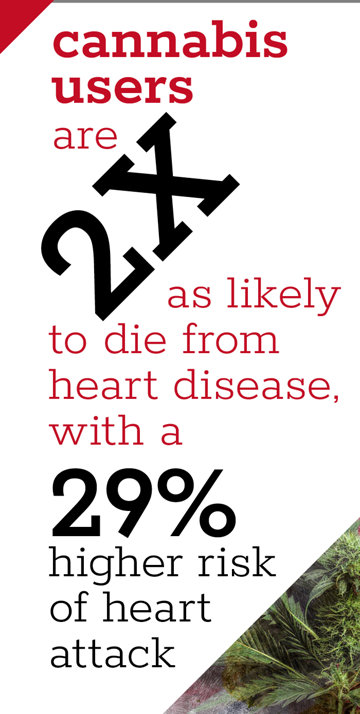
Yet another study in the journal Heart, combining scientific data from more than 200 million people, found that pot users were twice as likely to die from heart disease, including a 29 percent higher risk of heart attack and a 20 percent higher risk of stroke compared with those who don’t use the substance.
So “medical” or recreational, marijuana is far more dangerous than its promoters will admit.
Remember that when you hear that 10 doctors are driving over half of all marijuana prescriptions in the United Kingdom.
Perhaps you should have a word with them.