

“Research demonstrates that the single most destructive element present in our current culture is drugs.” —L. Ron Hubbard
At 8, she wrote the president, offering to help Afghan children.
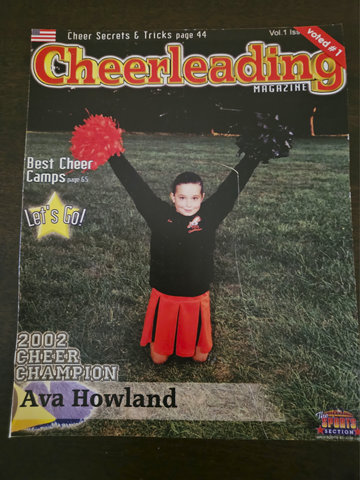
At 9 and 13, her picture was displayed on magazine covers—a cheerleading champion.
And at 24, she became a statistic—one of some 30,000 Americans lost to fentanyl in 2018.
“When you lose a child, everything changes.”
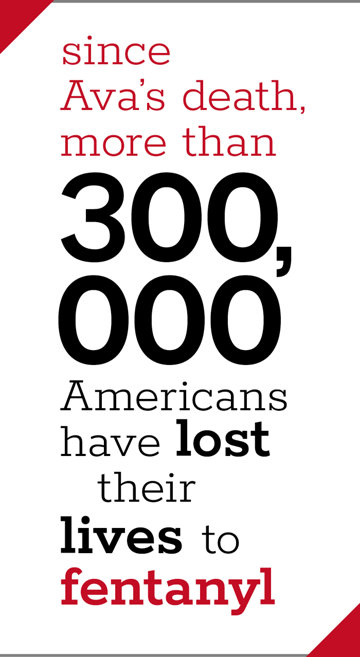
In the seven-plus years since Ava Michelle Howland’s death, over a quarter million more souls have been taken by fentanyl, a synthetic opioid up to 50 times stronger than heroin and 100 times stronger than morphine.
“When you lose a child, everything changes,” says Ava’s mom, Debbie.
Once the initial waves of shock passed, Debbie tried to understand what went wrong. After all, Ava had spent 18 months in Florida between labs, doctors, treatment centers, more doctors and sober homes to the tune of $1.5 million.
Ava had never intended to become a user—no child does. Ava didn’t want to die—no child does. So Debbie began investigating—and advocating. She connected with other parents who had lost children to fentanyl. She volunteered for groups, researched and learned.
She discovered that it’s not just drug dealers who profit from destroying lives through addiction. Drug treatment facilities do, too.
The scam is known as the Florida Shuffle.
Bearing a closer resemblance to a profit-making brokerage than to actual care, the Florida Shuffle involves a rehab center or sober living house recruiting a drug user with health insurance. The facilities then bill the insurance company—up to $4,000 for a simple urine test—and deliver so-called “treatment.” Then, when the patient “completes” the program, he or she relapses, and the cycle repeats, with the patient returning to the center for “treatment,” all on the insurance company’s dime.
That is, until the insurance caps out.
Debbie counts herself among the legion of parents who trusted the facilities over their addicted children. “I kept blaming her,” she tells Freedom, “and she kept saying, ‘No, mom, you don’t understand. They’re killing us down here.’ Unfortunately, every single thing she told me was true.”
Evidence that the people “treating” Ava prioritized profit over care can be seen in their prescription of the psychiatric drug clonazepam, also sold as Klonopin. Its literature includes this stark warning: “exposes users to risks of abuse, misuse and addiction, which can lead to overdose or death.”
Debbie says the drug only worsened Ava’s condition.
Now she, along with many other parents whose children were caught up in the “shuffle”—be it Florida’s, Arizona’s, California’s or another state’s—have made inroads in raising awareness about “patient brokering.”
But the dismantling of a machine that profits off drug abuse doesn’t address the core crisis of drug abuse itself, or save other young people from the fate Ava suffered.
So Debbie kept searching.
“That’s my Ava,” she smiles, “bringing awareness all over the world.”
Through a friend, she discovered the Foundation for a Drug-Free World (FDFW), a nonprofit that delivers the world’s largest nongovernmental drug prevention program, supported by the Church of Scientology. The aim is to reach young people with the facts before the dealers sell them on the lies. Thus armed with the truth, they can choose to live a drug-free life.
“The more I saw of their information, the more I wanted to be a part of what they do,” Debbie tells Freedom.
She opens The Truth About Fentanyl booklet and points to a photo. “That’s my Ava,” she smiles, “bringing awareness all over the world.”
The Truth About Fentanyl is one of 15 Drug-Free World booklets, each exposing a different dangerous and addictive drug. To date, more than 170 million Truth About Drugs booklets have educated people in 20 languages across every nation of Earth, empowering at-risk youth with potent facts.
“Education is key,” Debbie says. “It’s effective. It’s more effective than anything Ava was involved in. These pamphlets are small enough. You can flip it into your pocket. But they’re so thorough.”
Ava loved the beach, rapping, making her mom laugh and being a free-spirited soul. “She was smart as a whip,” Debbie says, “and she loved helping others.
“She could have been anything she wanted to be, except dead.”
As Debbie’s advocacy gained momentum, her daughter’s image began appearing on billboards all over the country, including one in Times Square last summer. Another is now up in Tidewater Trail, Virginia.
“It’s my Christmas present to her,” Debbie says, “bringing awareness in her name.”
Debbie has also brought Ava’s story to life in print. A coloring book, The Light They Leave Behind, includes Ava as an angel, along with other youth fentanyl stole from this world.
Thanks to her mother’s tireless advocacy, Ava Michelle Howland is now on a mission far more sweeping than any she was able to pursue before fentanyl snatched away her future—as an angel leading millions of youth, one by one, away from the abyss of drugs, and toward the light of life itself.