

“Human rights must be made a fact, not an idealistic dream.” —L. Ron Hubbard
She has just met with Cabo Verde’s current and former minister of education, sharing the YHRI materials and stressing the importance of mandating human rights education. Former minister Ms. Vera Duarte, also a former judge, agrees that the island nation needs human rights training in every school.
“I am 99 percent, no, 100 percent sure she will get a law proposed and she will push it through,” Mary Shuttleworth tells Freedom. “I love it. I just love it!”
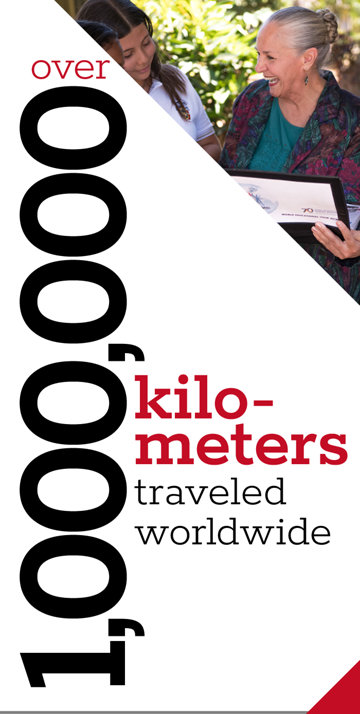
Cabo Verde is just the latest stop on Ms. Shuttleworth’s World Educational Tour—an annual voyage circling the globe that has covered more than 90 countries and over a million kilometers to date—championing the urgency of teaching human rights, specifically the United Nations Universal Declaration of Human Rights.
“The majority of people are good people. Educate them on their rights, and they’ll see how ridiculous discrimination is.”
As she and I speak, she puts the finishing touches on a letter to a youngster in Nepal, urging him to apply for a visa to attend the upcoming International Human Rights Summit at the United Nations in July. It is crucial, she explains, that young people like him participate and share all his leadership experience using the YHRI materials in his community and country because “almost half the world’s population is under 25 and they are hardest hit by the world’s inequalities and injustices.”
Hence, YHRI’s emphasis on youth. Young people have the most at stake and are our greatest hope for a better, more peaceful future.
A teacher by training and temperament, Mary knows that what you don’t know can hurt you. Ignorance of our basic human rights has led to countless abuses being perpetrated and tolerated globally. These 30 rights were adopted by the United Nations in 1948 as the Universal Declaration of Human Rights (UDHR). They include the right to education, the right to equality under law, the right to believe as one chooses and, most importantly, Article 29, our “duties to the community”—the right and responsibility to share these rights.
“Discrimination is everywhere,” she says. “I call it the ‘too’s.’ Too tall, too short, too rich, too poor, too black, too white, too pink, too purple—too, too, too, too, too, too! The list is endless. But the majority of people are good people. Educate them on their rights, and they’ll see how ridiculous discrimination is.”
And educate them she has. Recognizing that children and young adults struggled to understand the formal language of the UDHR, Mary founded Youth for Human Rights International in 2001 to make human rights education accessible to youth. To simplify the UDHR, she created the What Are Human Rights? booklet and launched major initiatives, including the World Educational Tour and the annual International Human Rights Summit hosted at the United Nations. She also collaborated with her 19-year-old son, filmmaker Taron Lexton, to develop the concept for what became the international award-winning hip-hop UNITED anti-bullying music video. Speaking directly to the young people of the world, the video’s universal message of tolerance and peace has reached more than 50 million. This was followed by educator’s guides, videos illustrating the 30 universal rights, online training and more—with materials translated in 27 languages.
On behalf of YHRI, Mary Shuttleworth visits schools, orphanages and shelters, connects with children, confers with local and national leaders, makes friends, organizes conferences and establishes YHRI groups eager to share their newfound rights. Radio hosts have spread her message, online media have carried it and international TV has broadcast it. Mary has thus transcended cultures and borders to reach people from every walk of life, bringing human rights education to millions.
With fiery intensity, she proclaims: “To build peace, we need education, my friend!”
That drive to get the world educated on human rights and get it done now was forged long before her global campaign began. Growing up in apartheid South Africa, Mary Shuttleworth witnessed the bitter fruits of discrimination and human rights abuse.
“In apartheid, you literally don’t see the ‘other half.’ Apartheid means separate development. As children, you’re invisible to them, they’re invisible to you,” she explains.
“Moreover, in any regime, there are two main targets: lawyers and journalists. And if a lawyer or journalist sticks their neck out, they could be ‘disappeared.’”
Mary’s father belonged to the former class of targets. Dead set against apartheid, the attorney yet knew the consequences of speaking out. But despite the danger, he also knew he must share his convictions with his children.
“If my father opened his mouth and made a sentence that I could quote as an innocent child—‘Well, my daddy says blacks and whites shouldn’t be separated’—my daddy wouldn’t be home when I got home.”
So instead of using words, he used play. He and other like-minded parents—black and white—gathered their children on a farm, set out plates of sliced oranges and sandwiches on a table, tossed them a ball and said, “We’re busy. There are the oranges and sandwiches. Go and play.”
That’s what kids do—given a ball and some time. “We didn’t care—we were all kids with a ball. It was just, ‘Go and play.’”
But after a while, Mary noticed something that puzzled her. Where are these kids when we’re not on the farm together? Where do they go to school? Why don’t I ever see them?
“The world I saw on the farm—one of unity—was not the world that I saw day to day. So where was this other world?”
Even while later studying in Europe as a teenager, where she also saw discrimination, the experience stayed with her. Young people from all walks of life getting along together—it was possible, it could happen. And it was that realization that later sparked the idea of an annual International Human Rights Summit—a three-day gathering hosted at the United Nations where youth from around the globe who have worked to advance human rights come together and unite.
And so they have each year—from Australia to Zimbabwe, they fly in from around the world—to share how they’ve used the YHRI materials and delivered the message of human rights in their own lands.
“So, you have this melting pot of kids who’ve never met, like on the farm. We have a structured conference at the United Nations, and in the evenings, we say, ‘There’s the pizza.’ And in that same innocent spirit, ‘Go and play.’”
“THAT’S the melting pot! Right there! THAT’S what creates friendships and understandings and what-have-you’s. One young boy from Ghana met someone from Kenya and said afterward, ‘I never knew what they looked like before!’”
“Where, after all, do universal human rights begin? In small places, close to home.”
Mary’s push to turn the Universal Declaration of Human Rights from a document into a real-world reality is shared by other powerful voices. Nobel Peace laureates are among the many who have come out in support of Youth for Human Rights. José Ramos-Horta, president of Timor-Leste, “touched my heart,” she says. He was so impressed by the YHRI campaign that he personally translated the materials into Tetum and promoted them in his country. Timor-Leste is now the official UN mission sponsor of the annual international summit.
Another laureate, Oscar Arias Sanchez, championed and ultimately helped pass a law in Costa Rica, mandating human rights education in all schools. “It’s the first nation in the world to do that!” she says. “Imagine: Every child will know their rights and can teach others as well! Wonderful!”
In 2019, Mary achieved a great personal and organizational milestone when she was awarded the Peace Summit Medal for Social Activism at the World Summit of Nobel Peace Laureates for YHRI’s “work to educate the youth of the world on the importance of human rights, through the Universal Declaration of Human Rights.”
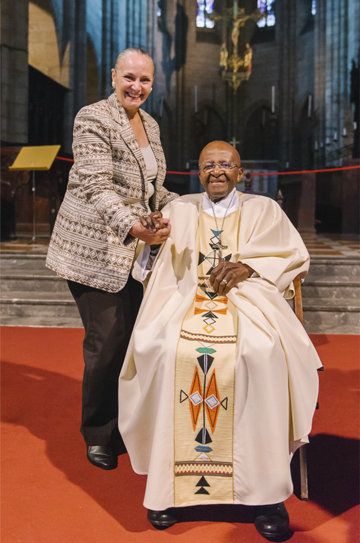
Presenting the award to Mary was Nobel Peace laureate F.W. de Klerk, the South African president who handed over power to Nelson Mandela. They were awarded the Nobel Peace Prize together in 1993.
When asked to describe her reaction, “Goosebumps!” is her reply.
Because human rights are something we all have a stake in, YHRI’s work is carried forward by people from every corner of society. Former gang members in Timor-Leste, inspired by what they learned from YHRI, laid down their weapons, picked up booklets and began distributing them, leading human rights workshops throughout the country.
Mary recalls a five-year-old girl with a speech disability who was bullied in kindergarten and became so distressed she refused to go to school. Her mother found YHRI’s public service announcements—one for each human right—and played a few for her. She was captivated and suggested her classmates watch them too, believing they simply didn’t understand they were violating her rights. The teacher agreed and showed the videos to the class. The bullying stopped and the children became friends.
Shortly thereafter, the girl addressed delegates at the International Human Rights Summit, atop a box to help reach the podium. After sharing her story, she pointed to the audience and declared, “If I can teach human rights, you can, too!”
The room erupted in a standing ovation.
Nobel laureates, former gang members, delegates from a mosaic of nations, lawmakers, leaders, educators, children—real change, as Mary Shuttleworth puts it, “has to be a group effort.”
Eleanor Roosevelt, who chaired the drafting committee of the Universal Declaration of Human Rights, said it best in 1953: “Where, after all, do universal human rights begin? In small places, close to home.”
It is there—in neighborhoods, schools, workplaces—where the fate of human rights is ultimately decided.
Mary Shuttleworth understands this all too well. Human rights—like gravity or the air we breathe—are not granted by decree or debated into existence. They simply are. But unlike gravity or air, they only exist when people choose to live them, defend them and pass them on.
And so, the work of Youth for Human Rights International begins where it matters most—and where it always will: with individuals, in their own communities, turning knowledge into action and ensuring those rights are real for everyone, everywhere.
“To build peace, we need education, my friend!” she says.